Pickles That Make Simple Meals More Delicious
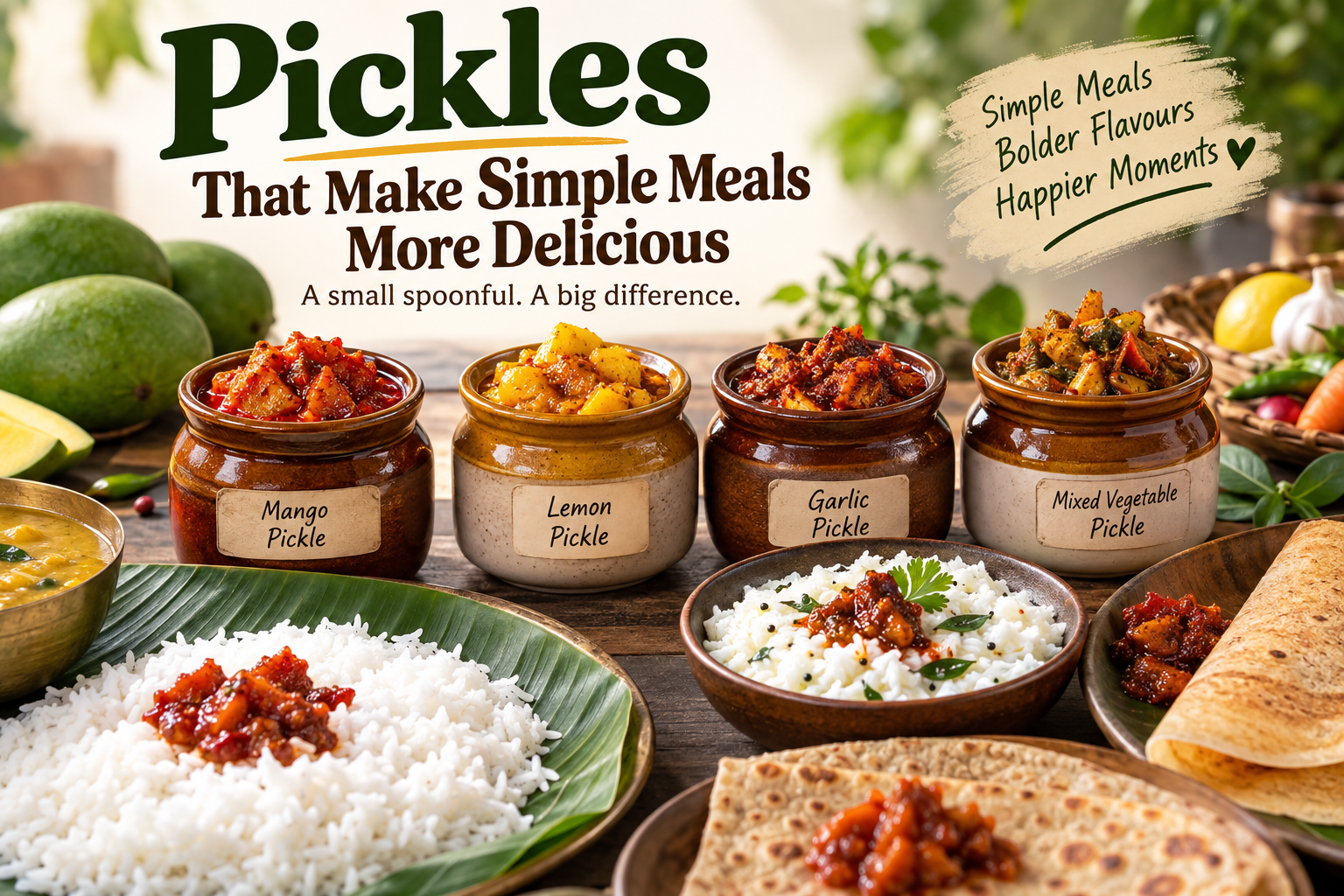
Pickles make simple meals more enjoyable because they add saltiness, acidity, spice, texture and intense flavour in a small serving. A spoonful of mango, lemon, garlic or mixed vegetable pickle can turn plain rice, curd rice, dosa, paratha or even a simple lunch into a more satisfying meal.
The key is choosing a pickle whose flavour complements the main dish rather than overpowering it.
Key Takeaways
- Pickles add tangy, spicy, salty and savoury flavours to everyday meals.
- A small serving can change the taste of otherwise simple food.
- Mango pickle works especially well with rice-based meals.
- Lemon pickle pairs naturally with curd rice and light meals.
- Garlic pickle can add depth to rice, paratha and Indian breads.
- Mixed vegetable pickles offer multiple textures and flavours in one accompaniment.
- Pickles can also be used beyond traditional meals—in sandwiches, wraps, chaats and snacks.
- Because pickles can be high in sodium, portion size matters.
Why Do We Love Pickles With Everyday Food?
Think about a simple plate of hot rice and dal.
It is comforting. It is filling. But add a small spoonful of spicy mango pickle, mix it with the rice and suddenly the entire meal feels different.
That is the magic of pickles.
Pickles are not usually meant to replace the main dish. Instead, they work as a flavour accent. Their combination of spice, acidity, saltiness, sweetness and texture can make familiar food more interesting.
This is particularly useful in Indian cooking, where accompaniments such as pickle, chutney, podi, papad and raita are often used to create contrast within a meal.
A simple meal doesn’t necessarily need more dishes. Sometimes, it just needs one bold flavour.
What Makes Pickles So Flavourful?
A good pickle brings several sensory elements together.
| Flavour element | What it adds to a meal |
|---|---|
| Saltiness | Enhances other flavours |
| Acidity | Adds brightness and tang |
| Spice | Creates heat and intensity |
| Oil | Carries spices and adds richness |
| Sweetness | Balances sour or spicy flavours |
| Texture | Adds bite and variety |
| Aromatic spices | Creates depth and complexity |
This combination explains why even a small quantity of pickle can have such a noticeable effect.
For example, the sharpness of lemon pickle can cut through the richness of curd rice, while the sweetness and heat of mango pickle can complement plain rice.
Best Pickles for Simple Indian Meals
Not every pickle pairs equally well with every dish. The best combination depends on the flavour and texture of the main food.
1. Mango Pickle: The Classic Choice
Mango pickle is one of the easiest ways to add bold flavour to a simple meal.
The combination of raw mango, spices, salt and oil creates a strong balance of sour, spicy and savoury notes.
Best with:
- Steamed rice
- Dal rice
- Curd rice
- Lemon rice
- Sambar rice
- Roti
- Paratha
Simple serving idea
Try hot rice with a little ghee, dal and a small spoonful of mango pickle.
You don’t need an elaborate side dish. The pickle supplies the punch.
2. Lemon Pickle: Bright, Tangy and Refreshing
Lemon pickle has a distinctive tanginess that works particularly well with mild and creamy foods.
The acidity provides contrast, which is why it can be an excellent companion to curd-based dishes.
Try lemon pickle with:
- Curd rice
- Plain rice
- Curd and roti
- Upma
- Pongal
- Paratha
For a quick lunch, even curd rice + lemon pickle + a little crunchy papad can create a satisfying combination.
3. Garlic Pickle: Bold Flavour for Rice and Breads
Garlic brings a naturally strong aroma and savoury character.
When combined with chilli, spices and oil, garlic pickle becomes a powerful accompaniment for people who enjoy intense flavours.
Pair it with:
- Plain rice
- Dal
- Curd rice
- Chapati
- Roti
- Paratha
- Dosa
Garlic pickle can also work particularly well when the main dish itself is relatively mild.
4. Mixed Vegetable Pickle: More Texture in Every Bite
Mixed vegetable pickle is useful when you want more than just heat and tang.
Depending on the recipe, vegetables can contribute different textures while the spice mixture ties everything together.
Great with:
- Rice
- Curd rice
- Roti
- Chapati
- Paratha
- Dosa
- Simple lunch bowls
The variety makes mixed vegetable pickle a practical choice for households where different people prefer different flavours and textures.
Pickle Pairing Guide for Everyday Meals
| Everyday meal | Pickle to try | Why it works |
|---|---|---|
| Curd rice | Lemon pickle | Tangy contrast |
| Plain rice + dal | Mango pickle | Adds spice and acidity |
| Paratha | Mango or garlic pickle | Cuts through richness |
| Dosa | Garlic or mango pickle | Adds stronger flavour |
| Pongal | Lemon pickle | Balances the mild taste |
| Chapati | Mixed vegetable pickle | Adds texture and spice |
| Sambar rice | Mango pickle | Creates flavour contrast |
| Lemon rice | Mango or garlic pickle | Adds another layer of spice |
| Upma | Lemon pickle | Adds tang to a mild dish |
How to Make a Simple Meal More Delicious With Pickles?
You don’t always need to change the entire recipe.
Instead, change how you use the pickle.
1. Mix Pickle with Hot Rice
One of the simplest combinations is hot rice, ghee and pickle.
The warmth of the rice helps distribute the oil and spices throughout the dish.
2. Pair Pickle With Curd Rice
Creamy curd rice and sharp pickle create a classic flavour contrast.
The mildness of curd rice gives the pickle room to stand out.
3. Serve Pickle with Paratha
Paratha can be rich and filling. A spicy or tangy pickle can provide the contrast needed to make each bite less monotonous.
4. Add Pickle to a Simple Lunch Bowl
Have leftover rice, dal and vegetables?
Add a small spoonful of pickle.
It can turn leftovers into something that tastes considerably more exciting without requiring another elaborate preparation.
5. Use Pickle in Snacks
Pickle doesn’t have to stay on the traditional Indian thali.
Try small amounts in:
- Sandwiches
- Wraps
- Rolls
- Toasted bread
- Stuffed parathas
- Chaats
- Rice bowls
The important thing is moderation. Pickle has a strong flavour, so a little can go a long way.
Can Pickles Make Boring Food Taste Better?
Yes. Pickles can make simple food more appealing by adding strong contrasting flavours such as sourness, saltiness, chilli heat and spice. This makes them especially useful with mild foods such as plain rice, curd rice, dosa, idli, upma and chapati.
However, the best result comes from matching the pickle to the meal rather than simply adding more pickle.
The Secret Is Contrast, Not Quantity
One common mistake is thinking that more pickle automatically means more flavour.
It doesn’t.
Pickles are concentrated accompaniments. Their job is to create contrast.
For example:
Mild food + strong pickle = balanced bite
But:
Strongly spiced curry + very spicy pickle = potentially overwhelming bite
That’s why portion size and pairing matter.
Start with a small spoonful and increase it according to your preference.
Traditional Pickles vs Modern Uses
Pickles have traditionally been served as a side accompaniment. Today, they can be used more creatively.
| Traditional use | Modern use |
|---|---|
| Rice accompaniment | Rice bowls |
| Side with curd rice | Wrap filling |
| Served with paratha | Sandwich spread |
| Part of a festive meal | Snack topping |
| Accompaniment to dosa | Chaat ingredient |
| Served with thali | Leftover meal enhancer |
This makes pickles more versatile than they may initially appear.
Are Pickles Healthy?
The answer depends on the type of pickle, ingredients, preparation method and quantity consumed.
Some fermented foods have attracted scientific interest because fermentation can influence food characteristics and the gut microbiome. A Stanford clinical trial involving 36 healthy adults found that a diet high in fermented foods increased gut microbial diversity and reduced several inflammatory markers over 10 weeks. However, these findings apply to fermented foods as a dietary category and should not be interpreted as proof that every commercial pickle provides the same effects.
There is also an important consideration: salt.
The World Health Organization recommends that adults consume less than 2,000 mg of sodium per day, equivalent to less than 5 grams of salt per day.
Therefore, pickle is best enjoyed as a flavourful accompaniment rather than consumed in large quantities.
A practical approach:
- Check the nutrition label when available.
- Pay attention to serving size.
- Balance salty foods elsewhere in the meal.
- Choose products made with clearly listed ingredients.
- Store opened pickle according to the manufacturer’s instructions.
What Should You Look for When Buying Pickles?
When choosing pickles online or from a store, don’t look only at the flavour name.
Consider:
Ingredients
Look for clearly listed ingredients and spices.
Texture
Do you prefer chunky mango pieces, softer lemon pieces or mixed vegetables?
Spice level
Some pickles are designed for mild everyday eating, while others are intentionally fiery.
Oil and salt
Check the nutrition information and serving size if available.
Packaging
Good packaging helps protect the product from contamination and supports shelf stability.
Product freshness
Check manufacturing and best-before information before purchasing.
Flavour profile
Choose according to how you normally eat.
If your meals are mild, a bold pickle may be useful. If your food is already heavily spiced, a tangier and less fiery option may provide better contrast.
7 Simple Meal Ideas With Pickles
Want to make everyday food more interesting without spending much time in the kitchen?
Try these combinations:
- Hot rice + ghee + mango pickle
- Curd rice + lemon pickle + papad
- Paratha + garlic pickle + curd
- Dosa + pickle + coconut chutney
- Dal rice + mango pickle
- Chapati + vegetable pickle + curd
- Pongal + lemon pickle
These combinations work because they bring together different textures and flavour profiles instead of relying on one dominant taste.
Why Homemade-Style Pickles Still Matter?
Modern consumers have more food choices than ever, but traditional flavours continue to have a special place at the dining table.
A well-made pickle can remind people of:
- Family meals
- Homemade cooking
- Festival food
- Grandmother’s recipes
- Regional cuisine
- Traditional spice combinations
That emotional connection is part of what makes pickles more than just another condiment.
For many households, opening a jar of pickle is almost like bringing a familiar flavour back to the table.
Frequently Asked Questions About Pickles
What food goes best with pickles?
Pickles pair well with rice, curd rice, dal, dosa, idli, chapati, roti and paratha. Mango pickle is especially versatile, while lemon pickle works well with mild foods such as curd rice and pongal.
Which pickle is best for curd rice?
Lemon pickle is a classic pairing for curd rice because its tangy flavour contrasts with the mild, creamy taste of curd rice. Mango pickle is another popular option for people who prefer a stronger spicy flavour.
Can I eat pickles with dosa?
Yes. Pickles can be served with dosa alongside chutney or sambar. Garlic and mango pickles can provide a stronger spicy and tangy contrast to a relatively mild dosa.
Which pickle goes well with paratha?
Mango and garlic pickles pair particularly well with paratha. The tangy and spicy flavours can balance the richness of the bread.
How much pickle should you eat with a meal?
A small serving is generally enough because pickles are highly concentrated in flavour. The appropriate amount depends on the product’s ingredients, nutrition information and your overall diet.
Are all pickles fermented?
No. Not all pickles are fermented. Some are made primarily through salting, acidification, oil preservation or combinations of these methods. The preparation process varies by recipe and region.
Can pickles be used in sandwiches?
Yes. A small amount of finely chopped pickle can add acidity, spice and crunch to sandwiches and wraps. Stronger pickles should be used sparingly so they don’t overpower the other ingredients.
Why does pickle make food taste better?
Pickle adds contrasting sensory elements such as acidity, saltiness, spice, aroma and texture. These characteristics can make otherwise mild foods taste more complex and interesting.
People Also Ask
What can I eat with Indian pickles?
Indian pickles can be eaten with rice, dal, curd rice, dosa, idli, chapati, roti, paratha and many other everyday dishes.
Which Indian pickle is most popular?
Mango pickle is one of the most familiar varieties, although preferences vary significantly by region, household and cuisine.
What is the best pickle for rice?
Mango pickle is a versatile choice for rice, while lemon pickle is particularly suitable for curd rice and other mild rice dishes.
Can pickle improve the taste of plain rice?
Yes. A small amount of pickle can add saltiness, acidity, spice and aroma to plain rice, especially when combined with ghee or dal.
How do you make simple food taste better?
Use contrasting flavours. A simple meal can become more interesting by adding accompaniments such as pickle, chutney, podi, curd, papad or fresh vegetables.
Conclusion: Sometimes, One Spoonful Is Enough
A delicious meal doesn’t always require a complicated recipe.
Sometimes, it is hot rice, a comforting side dish and one spoonful of a flavourful pickle.
Whether you prefer the sourness of lemon, the boldness of mango, the richness of garlic or the variety of mixed vegetables, the right pickle can bring contrast and character to everyday food.
The next time your lunch feels a little too ordinary, don’t immediately look for another recipe.
Reach for the pickle jar.
Explore different pickle varieties, find the flavours that match your favourite meals and keep a jar ready for those days when simple food needs a little extra magic.


Log in
By continuing, you accept the Website Regulations , Regulations for the sale of alcoholic beverages and the Privacy Policy
You dont have an account yet? Register Now