Imported Black Dates vs Local: Which Is Better?
Walk into a dry-fruit store and you may notice something interesting: the darkest, softest dates often look more premium and usually cost more.
But does imported automatically mean better?
Not necessarily.
When comparing imported black dates with locally sourced dates, the real difference comes down to the variety, growing region, maturity, drying method, storage, freshness and quality control. A well-handled local date can be a better choice than an imported date that has spent too long in storage.
So, if you’re wondering whether imported black dates are actually worth the extra money, here’s what you need to know.
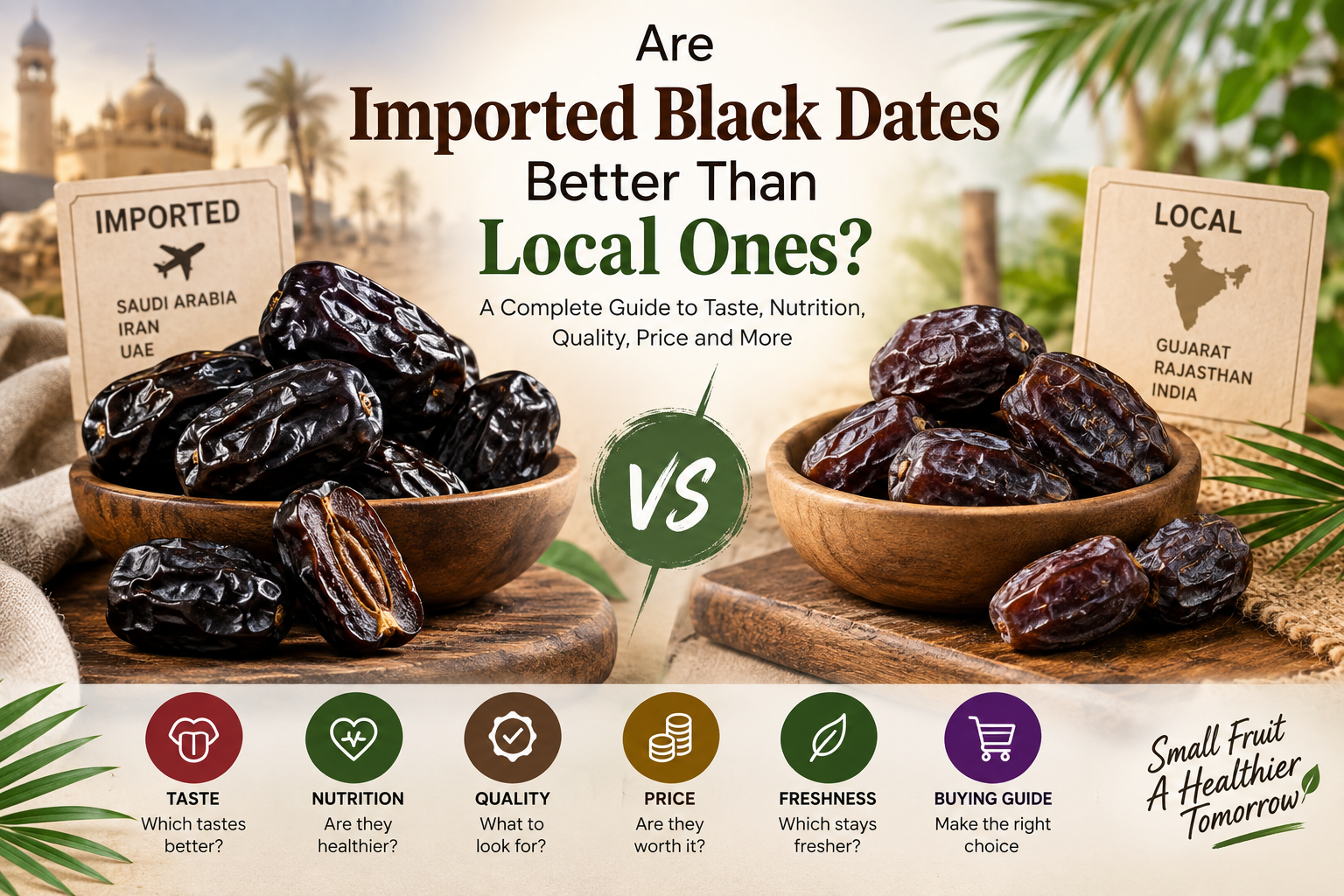
Are Imported Black Dates Better Than Local Ones?
Imported black dates are not automatically better than local dates. Imported varieties such as Safawi, Ajwa and certain Iranian black dates can offer distinctive taste, texture and appearance, while Indian-grown dates can provide freshness and potentially better value. The best choice depends on the date variety, quality, freshness and how the fruit was processed and stored, rather than its country of origin alone.
Key Takeaways
- Imported does not automatically mean higher quality.
- “Black dates” refers to several dark-coloured date varieties, not one universal variety.
- Imported varieties such as Safawi, Ajwa and Kimia/Mazafati-type dates can differ significantly in texture and sweetness.
- India also has date-palm cultivation, particularly in arid regions such as Gujarat and Rajasthan.
- Nutrition varies between date varieties, so colour alone isn’t a reliable indicator of health value.
- Freshness, storage conditions, moisture, cleanliness and packaging matter enormously.
- For everyday snacking, a good-quality local date can be excellent value.
- If you’re looking for a particular flavour or texture, an imported variety may be worth trying.
- Always check the origin, variety, ingredients, packaging and best-before information before buying.
What Are Imported Black Dates?
Imported black dates are dark-coloured dates brought into India from countries where specific date-palm varieties are traditionally cultivated and processed. Popular examples found in the Indian market include Safawi from Saudi Arabia and black or dark Iranian varieties such as Kimia/Mazafati-type dates.
The important point is that “black date” isn’t a precise botanical classification.
Several varieties can appear dark brown, reddish-black or nearly black depending on their cultivar and stage of ripeness.
For example, Safawi is commonly described as a dark or black Saudi date, while Iranian Mazafati dates are known for their very dark colour and soft texture. Chennai’s date market has also historically included imported Ajwa, Kimia and Iranian Mazafati varieties.
So when someone says, “I want black dates,” the next question should be:
Which variety?
That question can make a surprisingly big difference.
Are Local Dates Available in India?
Yes.
India has a long history of date-palm cultivation, particularly in regions suited to hot and dry conditions. Kutch in Gujarat is traditionally associated with date-palm cultivation, while date production has also expanded in parts of Rajasthan and other suitable regions.
The Indian Council of Agricultural Research notes that traditional date-palm varieties were grown in the Kutch-Bhuj region and that India has also developed cultivation of varieties such as Medjool under suitable conditions.
ICAR has also highlighted the importance of improved varieties, better planting material and post-harvest management for producing consistent-quality dates in India.
This means the comparison isn’t simply:
Imported = premium
Local = ordinary
The reality is much more nuanced.
Imported Black Dates vs Local Dates: What’s the Difference?
| Factor | Imported Black Dates | Local Indian Dates |
|---|---|---|
| Origin | Saudi Arabia, Iran and other date-growing regions | Grown within India |
| Variety | Often clearly identified premium cultivars | Depends on producer and region |
| Taste | Can range from mildly sweet to intensely sweet | Depends heavily on variety and maturity |
| Texture | Soft, chewy or moist varieties are available | Can range from soft to semi-dry and dry |
| Freshness | Depends on transportation and storage | Can have a shorter supply chain |
| Price | Often higher for premium varieties | Can offer better value |
| Appearance | Often selected for uniformity | Can vary by producer |
| Availability | Some specialty varieties are easier to find | Seasonal and region-dependent |
| Best for | Variety-specific taste and premium snacking | Everyday consumption and value |
The table reveals an important point: there isn’t a universal winner.
1. Taste: Imported Dates Can Offer More Variety
If you’re buying dates primarily for flavour, imported varieties can be interesting because different growing regions have developed distinctive cultivars.
For instance, Safawi is known for a dark appearance and soft, rich sweetness. Ajwa has a darker appearance but a different flavour profile and texture. Iranian Mazafati/Kimia-type dates are generally associated with a soft, moist texture.
Local Indian dates, on the other hand, can vary substantially depending on the cultivar and how ripe or dry they are when sold.
So which tastes better?
It depends on your preference.
Choose soft and moist dates if you enjoy a melt-in-the-mouth texture.
Choose firmer dates if you prefer something chewy and less sticky.
Choose very sweet dates if you want them for desserts, energy snacks or naturally sweet recipes.
2. Nutrition: Are Imported Black Dates Healthier?
This is where many marketing claims become misleading.
Imported dates are not automatically more nutritious simply because they are imported or darker.
Dates naturally provide carbohydrates and dietary fibre, along with minerals such as potassium and magnesium. However, the exact nutritional composition can vary between varieties and according to maturity and processing.
For reference, USDA-derived data for Medjool dates lists approximately 277 kcal, 75 g carbohydrate, 6.7 g dietary fibre and 696 mg potassium per 100 g.
Research comparing four date varieties—Ajwa, Safawi, Omani and Tunisian—also found differences in some nutritional measures, while potassium levels were relatively high across the varieties.
What does this mean for shoppers?
Don’t judge nutritional quality by colour alone.
Instead, consider:
- The variety
- Maturity
- Moisture content
- Processing
- Added ingredients
- Portion size
- Storage quality
In other words, a black colour is not a nutrition label.
3. Freshness: Where Local Dates Can Have an Advantage
This is one of the most overlooked differences.
An imported date may travel through several stages:
Farm → processor → exporter → importer → warehouse → distributor → retailer → customer
Every additional stage creates another opportunity for poor storage or temperature fluctuations.
A locally sourced product may have a shorter supply chain.
However, this does not mean every local date is fresher than every imported date.
A properly packed imported date stored under suitable conditions can remain excellent, while a poorly stored local product can deteriorate quickly.
What should you look for?
Good-quality dates should generally have:
- A pleasant natural aroma
- No mould
- No fermentation smell
- No unusual sourness
- No visible insect infestation
- No excessive leakage
- Clean packaging
- Proper labelling
Indian food standards specify quality and safety requirements for dates, including limits for moisture and extraneous matter and requirements relating to mould, insects and contamination.
4. Texture Matters More Than You Think
Two dates can look almost identical but feel completely different when you bite into them.
Soft dates
Usually:
- Moist
- Tender
- Juicy
- Easy to chew
- Naturally sticky
These are excellent for direct snacking.
Semi-dry dates
Usually:
- Chewier
- Less moist
- More resistant to crushing
- Suitable for everyday consumption
Dry dates
Usually:
- Firm
- Less juicy
- More concentrated in texture
- Often used in traditional preparations
Therefore, if you’re buying dates online, don’t just look for the word “black.”
Look for descriptions such as:
soft, moist, semi-dry, chewy, pitted, unpitted, naturally dried and the specific variety name.
5. Price: Why Are Imported Black Dates More Expensive?
Imported dates can cost more because the final retail price includes more than the fruit itself.
The price may reflect:
- International transportation
- Import handling
- Packaging
- Warehousing
- Distribution
- Brand positioning
- Variety
- Grade
- Sorting
- Retail margins
Premium varieties can command higher prices because of their reputation, availability and eating characteristics.
But paying more doesn’t guarantee better quality.
A simple rule:
Pay for the variety and quality you want—not merely for the word “imported.”
If you’re buying dates for your family every week, a good-quality Indian date may offer excellent value.
If you’re buying a specific premium variety because you enjoy its flavour and texture, the additional cost may be worthwhile.
Are Darker Dates Better Than Lighter Dates?
No. Colour alone cannot determine whether a date is better.
Date colour is influenced by the variety and stage of maturity. Some premium varieties are dark, while others are golden, amber or brown.
For example, the date market includes varieties with distinctly different colours and textures. The important comparison is therefore variety versus variety, not simply black versus brown.
Don’t use this shortcut:
Darker = healthier = better
Instead use:
Known variety + good quality + suitable texture + proper storage = better buying decision
Imported Black Dates vs Local Dates: Which Should You Buy?
Your decision should depend on what you’re actually looking for.
| If you want… | Consider |
|---|---|
| Premium imported varieties | Safawi, Ajwa or other named imported cultivars |
| Soft, moist texture | Moist/soft date varieties |
| Everyday family snacking | Good-quality local or mainstream dates |
| Better value | Compare price per 100 g, not just packet price |
| A specific flavour | Buy by variety rather than colour |
| Cooking and desserts | Choose according to sweetness and texture |
| Gifting | Uniformly graded, well-packed premium dates |
| Convenience | Pitted dates |
| Maximum transparency | Products with clear variety, origin and ingredient information |
How to Choose High-Quality Imported Black Dates
If you decide to buy imported black dates, don’t stop at the product photo.
Use this checklist.
1. Check the variety
“Black dates” is less informative than a specific variety name.
2. Check the country of origin
Look for clear origin information on the packaging.
3. Inspect the ingredient list
Ideally, you should know exactly what you’re buying.
FSSAI standards allow certain treatments and additives for dates, so reading the label is worthwhile.
4. Check the packaging
Avoid damaged, swollen or poorly sealed packs.
5. Check the date
Look at the manufacturing/packing information and best-before details.
6. Look at the fruit
Avoid dates showing:
- Mould
- Unusual fermentation
- Severe crystallisation
- Excessive damage
- Insect infestation
7. Don’t assume bigger means better
Large fruit can look premium, but size doesn’t automatically indicate superior nutrition or taste.
How to Store Black Dates Properly?
Even excellent dates can lose quality if they are stored poorly.
For packaged dates:
- Keep them in a cool, dry place according to the manufacturer’s instructions.
- Close the package properly after opening.
- Use clean, dry hands or utensils.
- Refrigerate soft or moist varieties if the packaging recommends refrigeration.
- Avoid prolonged exposure to heat and direct sunlight.
Storage becomes particularly important for soft, high-moisture dates, because their texture and shelf stability differ from drier varieties.
Are Imported Dates Worth Buying?
Yes if you want a particular variety, flavour or texture that isn’t readily available locally.
Imported black dates can be an excellent choice for people who enjoy premium varieties such as Safawi or other dark, soft date cultivars.
But if your goal is simply to eat dates regularly, there is no nutritional rule saying that imported dates must be better.
A quality-focused buyer should compare:
Variety → freshness → texture → ingredients → origin → storage → price
rather than:
Imported → therefore premium
That small change in thinking can save money without sacrificing quality.
The Real Winner: Quality, Not Country of Origin
The question “Are imported black dates better than local ones?” sounds simple, but the answer isn’t.
A premium imported date may win on variety, flavour and texture.
A good local date may win on freshness, value and a shorter supply chain.
And sometimes, the best date is simply the one you enjoy eating consistently.
India’s own date industry has also developed considerably, with ICAR documenting date cultivation, improved varieties and efforts to improve production and post-harvest handling.
So next time you shop for dates, don’t ask only:
“Is this imported?”
Ask:
“What variety is this, how fresh is it, how was it handled, and is it worth the price?”
That’s a much smarter way to buy dates.
Which Black Dates Are Best for Everyday Eating?
For everyday snacking, look for dates that are:
- Naturally sweet
- Clean and well packed
- Pleasantly soft or chewy
- Free from mould or fermentation
- Clearly labelled
- Within their recommended shelf life
- Priced reasonably for their grade
If you’re buying for regular family consumption, consistency and value are often more important than prestige.
5. FAQs
Are imported black dates healthier than local dates?
Not necessarily. Imported and local dates can both provide carbohydrates, dietary fibre and minerals. Nutritional differences depend more on the specific variety, maturity and processing than simply whether the fruit was imported.
Why are imported black dates so expensive?
Premium imported dates can cost more because of their variety, grading, packaging, transportation, import handling, storage and distribution. Higher price does not automatically mean higher nutritional value.
What are the most popular black dates?
Popular dark varieties include Safawi and Ajwa, while Iranian markets also supply very dark, soft varieties such as Mazafati/Kimia. Availability varies by retailer and region.
Are black dates naturally black?
Some varieties naturally have very dark brown to black skin. Colour varies according to cultivar and maturity, so dark colour alone does not identify a particular variety.
Can I eat black dates every day?
Dates can be included in a balanced diet, but they are naturally carbohydrate- and sugar-rich. Portion size matters, especially if you are monitoring your total carbohydrate or calorie intake.
Should black dates be washed before eating?
For packaged dates, follow the manufacturer’s instructions. If washing is appropriate, handle them hygienically and dry them properly before storage. Always inspect the fruit before consumption.
Which is better: Ajwa or Safawi?
Neither is universally “better.” Ajwa and Safawi have different flavour, texture and size characteristics. Choose according to your preference and budget rather than assuming one variety is nutritionally superior.
Are Indian dates good quality?
They can be. India has established date-palm cultivation, particularly in regions such as Gujarat, and research and agricultural programmes have supported improved varieties and cultivation practices.
Do black dates contain added sugar?
Not necessarily. Many dates are naturally sweet without added sugar. However, consumers should check the ingredient list because FSSAI regulations permit certain treatments for dates, and individual products can differ.
Which dates are best for gifting?
Premium, clearly labelled varieties with attractive, hygienic packaging are generally better suited to gifting. Look for consistent size, appearance and quality rather than choosing solely by colour.
People Also Ask
Are imported dates better than Indian dates?
Not automatically. Compare the variety, freshness, processing, storage and price before deciding.
Why are some dates black?
Some date cultivars naturally develop dark brown or black skin as they mature.
What is the difference between Safawi and Ajwa dates?
Both can be dark-coloured Saudi dates, but they differ in size, texture, sweetness and flavour.
Are black dates good for health?
Dates provide fibre and minerals such as potassium, but they are also energy- and carbohydrate-dense. They are best enjoyed as part of a balanced diet.
How can you tell if dates are good quality?
Check the variety, packaging, appearance, aroma, texture, origin, ingredient list and best-before information.
Follow us on Instagram – Annai Food products2
shop premium imported black dates
explore our Ajwa dates


Log in
By continuing, you accept the Website Regulations , Regulations for the sale of alcoholic beverages and the Privacy Policy
You dont have an account yet? Register Now