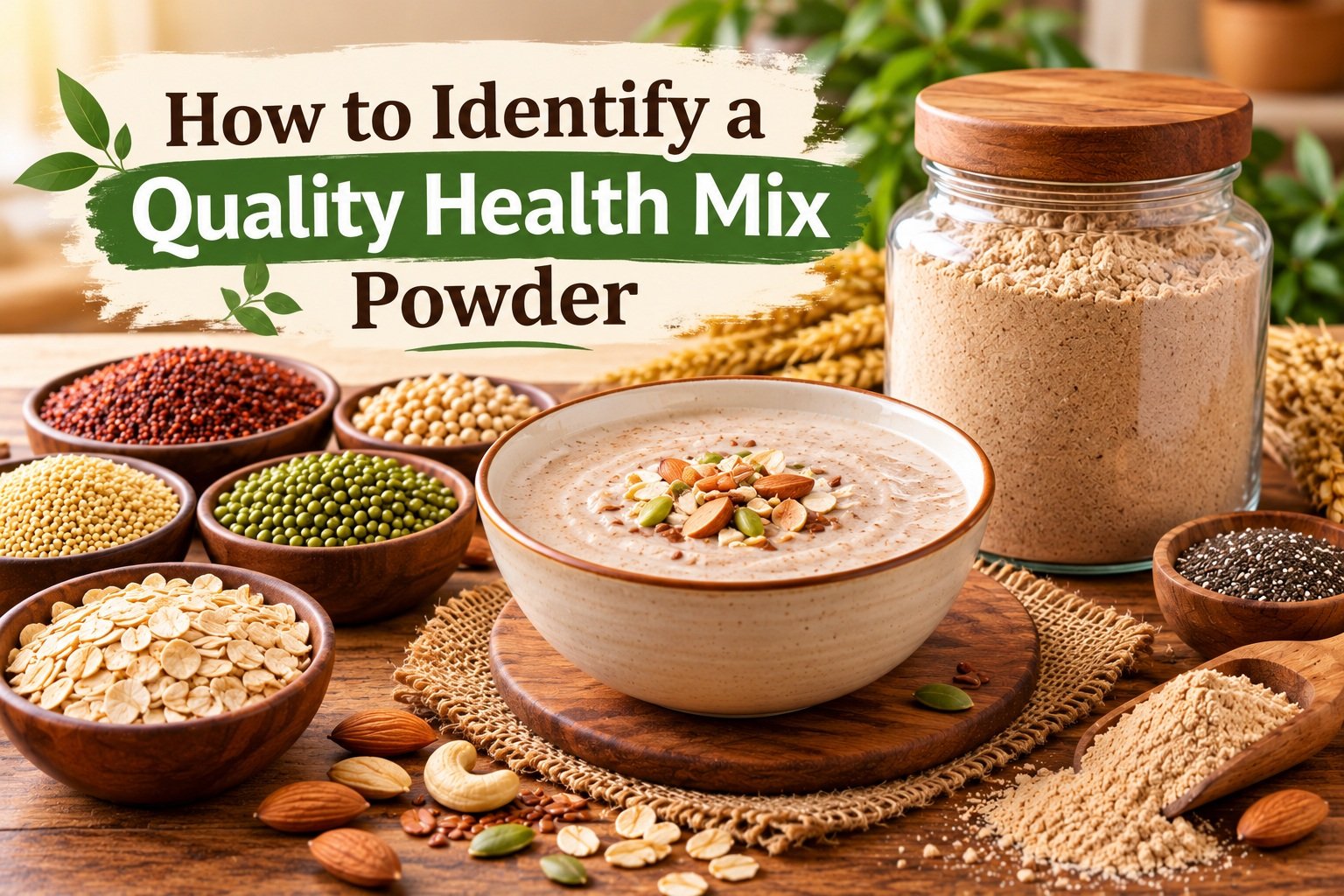
How to Identify a Quality Health Mix Powder: A Complete Buyer’s Guide
A health mix powder may look nutritious on the shelf, but how can you tell whether it contains the ingredients your family actually needs? From traditional millet-based blends to sprouted grain powders, not all health mixes offer the same nutritional value, ingredient quality or taste.
If you are buying health mix powder for your daily breakfast, your children or your family’s regular diet, understanding the label is just as important as choosing a familiar brand.
Quick answer: How do you identify a quality health mix powder?
A quality health mix powder should have a clearly listed ingredient profile, suitable nutritional values, minimal unnecessary added sugar, hygienic packaging, a fresh aroma and a reliable manufacturing date. Look for whole grains, millets, pulses, nuts or seeds that suit your dietary needs. Always check the nutrition label and allergen information instead of relying only on claims such as “natural” or “healthy.”
In this guide, you will learn how to evaluate health mix ingredients, compare products, recognise potential warning signs and choose a blend that fits your everyday routine.
Key Takeaways
- Read the ingredients list: Look for identifiable grains, millets, pulses, nuts and seeds.
- Check added sugar: Do not assume a health mix is sugar-free simply because it contains millets.
- Compare nutrition labels: Pay attention to protein, dietary fibre, carbohydrates and serving size.
- Inspect freshness: Check the manufacturing date, expiry or best-before date and storage instructions.
- Look beyond marketing claims: “Natural,” “traditional” and “multigrain” do not automatically mean nutritionally superior.
- Choose according to your needs: A blend for a quick breakfast may differ from one designed for a particular age group or dietary preference.
What Is a Quality Health Mix Powder?
A quality health mix powder is a food blend made from suitable ingredients, processed and packaged under hygienic conditions, with clear labelling and nutritional information. Depending on the recipe, it may contain cereals, millets, pulses, nuts, seeds and other food ingredients.
Traditional Indian health mixes often use ingredients such as ragi, pearl millet, green gram, roasted gram and other grains. Some recipes also include sprouted grains to suit a particular preparation method.
However, the number of ingredients alone does not determine quality. A simple blend with well-chosen ingredients can be a better fit for your needs than a long ingredient list with unnecessary sweeteners or ingredients you cannot tolerate.
The right choice depends on the formulation, ingredient quality, preparation method, portion size and your overall diet.
1. Check the Health Mix Ingredients First
The ingredient list is one of the most useful places to begin when comparing health mix powders. It tells you what the product contains rather than what the packaging promises.
Which ingredients should you look for?
The ideal ingredients depend on the product’s purpose. Here are some commonly used ingredients and their nutritional contributions.
| Ingredient | What it contributes | What to check |
|---|---|---|
| Ragi (finger millet) | Carbohydrates, dietary fibre and minerals, including calcium | Whether it is a major ingredient in the blend |
| Pearl millet (bajra) | Energy, fibre and minerals | Ingredient quality and processing |
| Green gram (moong dal) | Plant protein, carbohydrates and fibre | Whether it suits your dietary needs |
| Roasted gram | Plant protein and carbohydrates | The ingredient’s proportion and freshness |
| Oats | Carbohydrates and beta-glucan fibre | Whether oats suit your dietary requirements |
| Almonds and other nuts | Unsaturated fats, protein and micronutrients | Nut-allergen declarations and freshness |
| Sesame seeds | Unsaturated fats, protein and minerals | Allergen information and storage |
| Sprouted grains or pulses | Nutrients in a formulation that uses a sprouting process | How the product is processed and dried |
These are general nutritional characteristics, not a guarantee that every health mix contains meaningful quantities of each nutrient.
Why does the ingredient order matter?
In packaged foods, ingredients are generally listed in descending order by weight at the time of manufacture, subject to applicable labelling rules.
For example, consider two hypothetical products:
- Blend A: Ragi, green gram, roasted gram, almonds and cardamom.
- Blend B: Sugar, cereal flour, maltodextrin, millet flour and flavouring.
Blend A appears to prioritise grains and pulses, while Blend B begins with sweetening or carbohydrate ingredients. This does not establish the complete nutritional quality of either product, but it gives you a useful starting point for further comparison.
Buying tip: Look beyond the front label. Turn the packet around and read the complete ingredients list before making your decision.
2. Compare the Nutrition Information
A good-looking ingredient list is useful, but the nutrition panel helps you understand what the finished product actually provides.
Which nutrients should you check?
Start with these five details:
- Protein: Useful when comparing blends containing pulses, legumes or nuts.
- Dietary fibre: Helps you assess the fibre contribution per serving.
- Total carbohydrates: Important because grain-based health mixes are often carbohydrate-rich.
- Total and added sugars: Helps you distinguish naturally occurring sugars from sugars added during formulation.
- Energy: Shows how much energy a stated serving provides.
Also check the serving size. A product that lists 10 grams of protein per 100 grams does not provide 10 grams of protein in a 25-gram serving.
For example, if a powder contains 12 grams of protein per 100 grams, a 30-gram serving provides approximately 3.6 grams of protein before accounting for anything else added during preparation.
This simple calculation makes comparisons more practical.
Is a higher protein content always better?
Not necessarily. A higher-protein blend may suit someone looking to increase their protein intake, but protein is only one part of a balanced diet. Fibre, energy, added sugar, serving size, taste and affordability also matter.
Similarly, a product containing many millets is not automatically better than a blend that combines grains and pulses in appropriate proportions.
The most useful question is: What does one normal serving contribute to your overall diet?
3. Look for Added Sugar and Unnecessary Ingredients
Some health mixes are designed to be prepared with milk, water or other ingredients, while others are sold as ready-sweetened blends. This distinction matters when choosing a product for everyday consumption.
Check the ingredients list for terms such as sugar, glucose syrup, maltodextrin and other sweetening ingredients. Their presence does not automatically make a product unsuitable, but their quantities and intended use are worth considering.
Is a health mix without added sugar better?
A blend without added sugar gives you more control over sweetness, particularly if you plan to add fruit, milk or another ingredient during preparation. However, “no added sugar” does not mean the product contains no naturally occurring sugars or carbohydrates.
Likewise, a sweetened health mix may still fit into some diets, depending on its composition and portion size.
A practical approach: Compare similar products using the nutrition panel, check the ingredient list and choose a sweetness level that fits your household’s preferences and dietary requirements.
Do not assume that every product labelled “sugar-free,” “diabetic-friendly” or “weight management” is appropriate for a particular medical condition. Check the full label and consult a qualified healthcare professional when needed.
4. Understand Sprouted and Roasted Ingredients
Processing methods can affect the nutritional composition, flavour, texture and storage stability of a health mix.
Two methods commonly associated with traditional grain and pulse blends are sprouting and roasting.
What is sprouted health mix powder?
Sprouting involves allowing grains or pulses to germinate under controlled conditions before further processing. Germination can alter certain nutrients and reduce some antinutritional factors in particular ingredients.
However, the result depends on the ingredient, germination conditions, drying process and final formulation. Sprouting does not automatically make every product more nutritious, and it does not eliminate every food-safety risk.
Is roasted health mix powder a good choice?
Roasting can improve flavour and aroma and change the texture of grains and pulses. Appropriate processing also helps manufacturers develop a product suitable for storage and preparation.
When comparing roasted or sprouted health mixes, consider:
- Whether the manufacturer clearly describes the process.
- Whether the ingredients have a fresh, characteristic aroma.
- Whether the finished powder has been packaged and stored appropriately.
- Whether the label provides clear preparation and storage instructions.
Be cautious of burnt odours, unusual discolouration, visible moisture or signs of contamination. Appearance and smell can help identify obvious problems, but they cannot prove that a food is microbiologically safe.
5. Inspect Packaging, Manufacturing Details and Freshness
Even a well-formulated health mix can lose quality if it is poorly stored or packaged.
Before buying, check the following details:
| Label or packaging detail | Why it matters |
|---|---|
| Manufacturing or packing date | Helps you understand how recently the product was packed |
| Expiry or best-before date | Indicates the manufacturer’s stated shelf-life information |
| Ingredient list | Identifies the actual contents |
| Nutrition information | Supports meaningful product comparisons |
| Allergen declaration | Helps identify ingredients that may cause allergic reactions |
| FSSAI details, where applicable | Helps you check the food business’s regulatory identification |
| Manufacturer or marketer details | Provides traceability information |
| Batch or lot number | Helps identify the specific production batch |
| Storage instructions | Explains how to maintain product quality after purchase |
Choose sealed packaging without tears, leaks, damaged closures or visible moisture. Avoid products with an unusual smell or signs of insects, mould or contamination.
For products sold online, review the product description and label images before ordering. If the online listing does not show the complete ingredients, nutrition information or manufacturer details, ask the seller for clarification.
Remember that a registration or licence number is not, by itself, proof of superior nutritional quality. It is one part of assessing a product’s identity and regulatory information.
6. Do Not Judge Quality by Colour, Texture or Price Alone
A common mistake is assuming that a darker powder, a finer texture or a higher price means better quality.
In reality, the colour of a health mix depends on its ingredients and processing. A ragi-rich blend may look different from a blend containing rice, oats or roasted gram. Similarly, particle size depends on grinding and formulation.
Price can reflect ingredient costs, packaging, manufacturing, distribution and brand positioning. It does not independently prove that one blend is more nutritious than another.
What can you assess at home?
Once the packet has been opened, follow the manufacturer’s storage instructions and look for obvious changes in:
- Aroma
- Colour
- Texture
- Moisture or clumping
- Signs of pests or mould
Use clean, dry utensils when handling the powder and close the packet securely after each use.
If you notice unusual odours, moisture, mould or contamination, do not taste the powder to determine whether it is safe. Discard it or contact the seller or manufacturer.
7. Compare Two Health Mix Powders Before Buying
Use this simple comparison framework when shopping for a health mix.
| Buying factor | Product A | Product B |
|---|---|---|
| Main ingredients | Clearly identified grains and pulses | Check whether the main ingredients match your needs |
| Added sugar | Check the label | Check the label |
| Protein per serving | Calculate from the nutrition panel | Calculate from the nutrition panel |
| Fibre per serving | Compare like-for-like serving sizes | Compare like-for-like serving sizes |
| Allergen information | Clearly stated | Clearly stated |
| Manufacturing details | Available and legible | Available and legible |
| Packaging condition | Sealed and intact | Sealed and intact |
| Storage instructions | Clear | Clear |
| Price per serving | Compare after calculating | Compare after calculating |
To calculate the price per serving, divide the pack price by the number of servings stated or reasonably calculated from the net weight and serving size.
For example, a 500-gram pack used at 25 grams per serving provides 20 servings. If the pack costs ₹200, the powder costs ₹10 per serving, excluding milk, fruit or other additions.
This approach helps you compare value without assuming that the most expensive product is the best.
8. Choose a Health Mix That Suits Your Family
A quality product is not necessarily the same for every household. Your choice should reflect how you intend to use it and which ingredients suit your dietary needs.
For a daily breakfast
Look for a blend with clearly identified grains and pulses, suitable fibre and protein content, and a manageable serving size. Consider how it fits alongside the other foods you eat during the day.
For children
Check the age suitability, preparation instructions, allergens and nutrition information. A traditional health mix should not automatically be treated as a complete meal or a substitute for a varied diet. Follow age-appropriate feeding advice, particularly for infants and toddlers.
For adults with busy schedules
A health mix may offer a convenient way to prepare a grain-based drink or porridge. Compare the nutritional information and choose a preparation method that fits your routine.
For people with dietary restrictions
Read allergen statements carefully. Millet-based products may still contain other grains, pulses, nuts or ingredients that are unsuitable for some people. Also, a product containing grains should not be assumed to be gluten-free unless the formulation and applicable labelling support that claim.
People managing diabetes, kidney disease or other medical conditions should choose products according to individual dietary advice rather than relying on broad marketing claims.
9. How Should You Store Health Mix Powder?
Storage affects freshness, flavour and shelf life. Always follow the instructions printed on the packet because formulations and packaging can differ.
As a general practice:
- Keep the powder in a cool, dry place.
- Use an airtight container if transferring it from the original package.
- Use a clean, completely dry spoon.
- Avoid storing it near steam, heat or direct sunlight.
- Close the package promptly after use.
- Follow any refrigeration instructions provided by the manufacturer.
Ingredients such as nuts and seeds contain fats that may develop rancid flavours under unsuitable storage conditions. Products containing moisture or improperly dried ingredients may also be more vulnerable to spoilage.
Do not rely on smell alone to determine safety, and never use a product beyond its stated expiry date.
10. Common Mistakes to Avoid When Buying Health Mix Powder
Avoid these common buying mistakes:
- Choosing only by the front label: Marketing claims do not replace the ingredient and nutrition panels.
- Assuming all millets are interchangeable: Different grains have different nutritional profiles and culinary properties.
- Ignoring added sugar: A millet-based product can still contain significant added sugar.
- Confusing protein per 100 grams with protein per serving: Always calculate the amount you actually consume.
- Assuming sprouted means superior: Processing quality and the final formulation still matter.
- Overlooking allergens: Nuts, sesame and certain grains or pulses may be unsuitable for some consumers.
- Buying oversized packs without checking usage: A smaller pack may be more practical if you consume the product infrequently.
- Treating health mix as a miracle food: No single powder can replace a varied, balanced diet.
A useful five-point buying checklist
Before adding a product to your cart, ask:
- Can I identify the main ingredients?
- Have I checked the protein, fibre, carbohydrate and sugar information?
- Is the package sealed and within its stated shelf life?
- Are the manufacturer and allergen details clear?
- Does the product fit my intended use, budget and dietary needs?
If you can answer these questions confidently, you are in a much better position to make an informed choice.
Conclusion: Choose Quality Over Marketing Claims
Identifying a quality health mix powder starts with understanding what is inside the packet. Read the ingredients list, compare nutrition per serving, check added sugar, understand the processing method and inspect the packaging before you buy.
A thoughtfully formulated health mix can be a convenient addition to a varied diet, but its value depends on its ingredients, preparation, portion size and how it fits into your everyday meals.
If you are exploring traditional grain-based nutrition, compare products carefully and choose one with transparent ingredient information, clear labelling and practical preparation instructions.
FAQs
1. How can I identify a quality health mix powder?
Check the ingredients list, nutrition information, added sugar content, manufacturing details and packaging condition. Choose a blend with clearly identified ingredients and suitable nutritional values. A reliable product should also provide clear storage instructions and allergen information.
2. Which ingredients should a good health mix contain?
Common ingredients include ragi, pearl millet, green gram, roasted gram, oats, nuts and seeds. The ideal combination depends on your nutritional needs and preferences. Check the actual ingredient proportions rather than judging quality by the number of ingredients.
3. Is homemade health mix better than packaged health mix?
Both can be suitable choices. Homemade health mix allows you to control the ingredients, while a packaged product offers convenience and consistent preparation. For packaged products, check labelling, freshness, processing and storage information.
4. Is sprouted health mix more nutritious?
Sprouting can change nutrient availability and reduce certain antinutritional factors in some grains and pulses. However, the benefits depend on the ingredients and processing method. Sprouted products are not automatically superior to every non-sprouted blend.
5. How do I know whether a health mix contains too much sugar?
Check the nutrition panel for total sugars and added sugars, where declared, and read the ingredients list for sweeteners. Compare similar products using the same serving size. Do not rely exclusively on claims such as “natural” or “multigrain.”
6. Can I drink health mix every day?
A health mix can be included in a daily diet if its ingredients suit your needs and it fits into your overall nutritional intake. Consider portion size, preparation method and added ingredients. It should complement a varied diet rather than replace all other foods.
7. How long does health mix powder last?
Shelf life varies according to ingredients, moisture levels, processing and packaging. Check the manufacturer’s expiry or best-before date and storage instructions. After opening, keep the powder dry, sealed and away from heat and moisture.
8. Is millet-based health mix suitable for children?
It may be suitable depending on the ingredients, preparation and child’s age. Check allergens and age-specific feeding guidance. Do not assume that a standard health mix is nutritionally complete for infants or young children.
9. Does a higher price mean better health mix quality?
No. Price alone does not establish nutritional quality. Compare ingredient composition, nutrition per serving, freshness, packaging and cost per serving before choosing.
10. What should I avoid when buying health mix powder?
Avoid products with damaged packaging, missing or unclear ingredient information, expired dates, unusual odours or visible contamination. Check added sugars and allergen declarations, and be cautious of unsupported claims promising specific health outcomes.
Buy health mix powder online
health mix is better than sugary breakfast cereals


Log in
By continuing, you accept the Website Regulations , Regulations for the sale of alcoholic beverages and the Privacy Policy
You dont have an account yet? Register Now