7 Things to Check Before Buying Honey Online
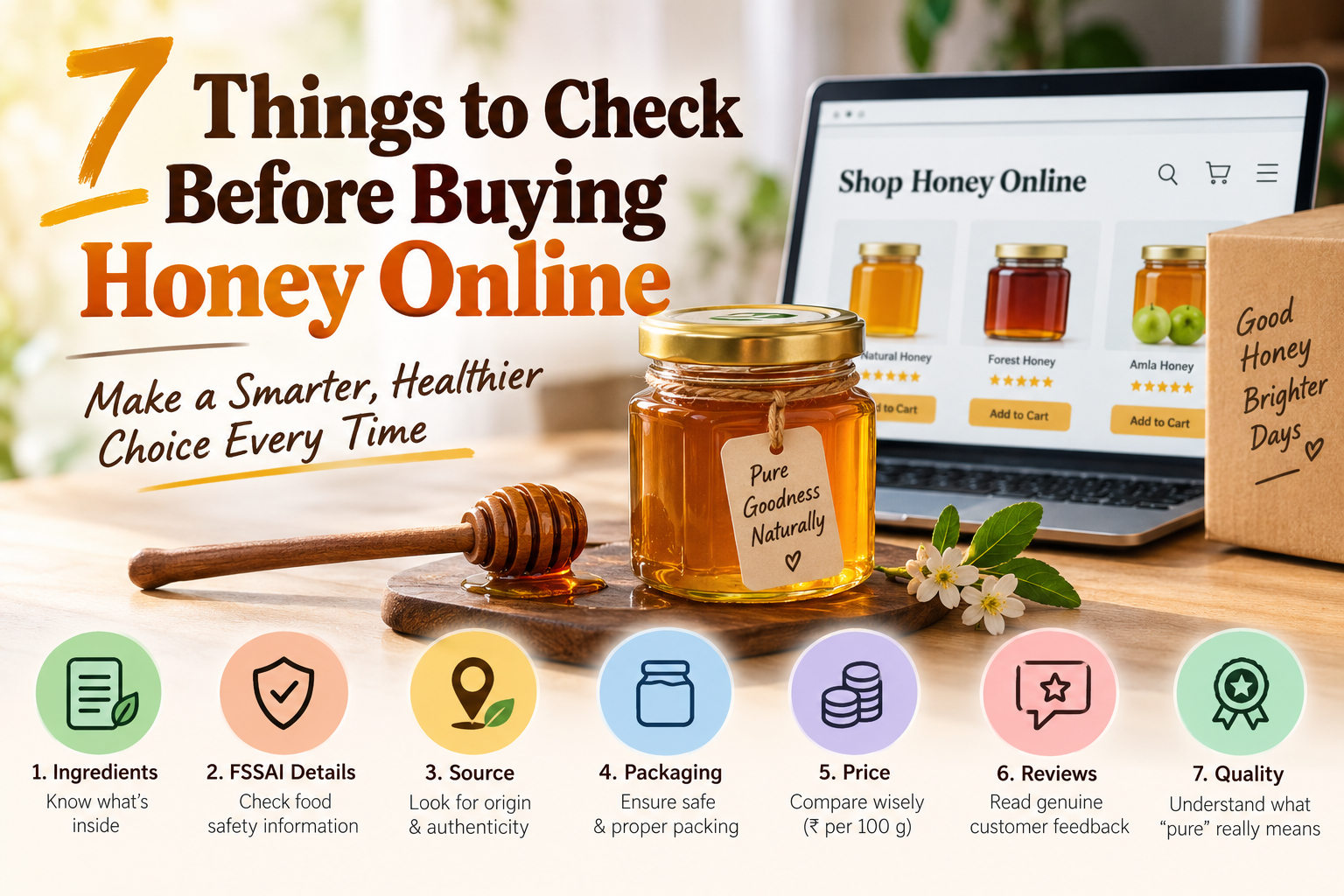
Buying Honey Online? Check These 7 Things First
Buying honey online looks simple: choose a bottle, add it to your cart, pay, and wait for delivery.
But there is one problem.
A good-looking honey bottle does not automatically mean you are buying a good honey product.
When shopping online, you cannot smell the honey, examine its texture closely, inspect the physical label, or ask the seller questions before placing your order. That makes the product description, ingredient list, food-safety information, packaging details, and seller transparency much more important.
Quick Answer: What should you check before buying honey online?
Before buying honey online, check the ingredient list, FSSAI information, product source, packaging, batch and date details, seller reputation, customer reviews, price, and delivery conditions. Also, don’t judge honey quality only by its colour, thickness, or whether it crystallizes.
This simple checklist can help you make a more informed purchase instead of choosing a product based only on its marketing claims.
Key Takeaways
- Read the ingredient list instead of relying only on words such as “natural” or “premium.”
- Check for the FSSAI logo and licence number on packaged food products sold in India.
- Look for clear information about the manufacturer, packer, brand owner, or source.
- Check the batch number, manufacturing/packing date and date marking.
- Don’t assume that expensive honey is automatically better.
- Crystallization is not, by itself, proof that honey is pure or impure.
- Read genuine customer reviews, particularly those mentioning packaging and delivery.
- Compare price per 100 g, rather than comparing bottle prices alone.
- Choose sellers that provide enough information for you to make an informed decision.
1. Check the Ingredient List Before Buying
The first thing to look at when buying honey online should not be the product photograph.
It should be the ingredient information.
For a product marketed specifically as honey, the ingredient information should be clear and consistent with what is being sold. If the product is a honey blend or flavoured product, the description should make that clear too.
This distinction becomes particularly important because online stores may sell several products that contain honey but are not simply plain honey.
What should you look for?
Before purchasing, check:
- Product name
- Ingredient list
- Net quantity
- Product description
- Added ingredients, if any
- Nutritional information
- Manufacturer or packer information
FSSAI’s labelling requirements for pre-packaged foods cover information such as the name of the food, ingredients, nutritional information, manufacturer details, net quantity, batch identification and date marking.
Plain honey vs honey-based products
| Product type | What to check |
|---|---|
| Plain honey | Ingredient information and honey description |
| Honey with Amla | Honey plus clearly identified additional ingredient |
| Honey with dry fruits | Honey and the specific dry fruits included |
| Flavoured honey | Flavouring/additional ingredients should be disclosed |
| Honey gift set | Check each product included in the package |
Important: Don’t assume that every product containing the word “honey” is the same as plain honey.
2. Look for FSSAI Information
When buying packaged food online in India, food-safety information deserves attention.
Look for the FSSAI logo and licence number on the product packaging or product images.
Current FSSAI labelling guidance states that the FSSAI logo and licence number of the brand owner should be displayed on the label, with additional licence information where the manufacturer, marketer, packer or bottler is different.
Why does this matter?
It gives consumers another piece of information they can use to identify the food business responsible for the product.
You can also use the FSSAI’s FoSCoS system to search food businesses using information such as company name or licence/registration number.
A useful online shopping habit
Before ordering, ask yourself:
“Can I clearly identify who is responsible for this food product?”
If the answer is unclear, investigate further before purchasing.
3. Check Where the Honey Comes From
“Pure honey” and “natural honey” are common phrases in online marketing. However, a stronger product page should provide more useful information than attractive adjectives.
Look for information about:
- Honey source
- Floral or botanical origin, where applicable
- Beekeeping or sourcing practices
- Processing information
- Manufacturer or producer
- Country of origin
- Packaging location
- Brand ownership
The international Codex Standard for Honey defines honey as a natural sweet substance produced by honeybees from plant nectar or related plant sources, which bees collect, transform, deposit, dehydrate and mature.
Does darker honey mean better honey?
No.
Honey naturally varies in colour, flavour, aroma and consistency. Codex notes that honey can range from nearly colourless to dark brown and can be fluid, viscous or crystallized.
So don’t choose a honey product simply because it looks darker or thicker in a photograph.
4. Don’t Ignore Batch, Date and Packaging Information
This is one of the easiest checks to overlook when shopping online.
A trustworthy packaged-food listing should provide enough information to identify the product and its shelf life.
Look for:
- Batch or lot number
- Manufacturing or packing date
- Expiry/use-by or best-before information, as applicable
- Net quantity
- Manufacturer/packer information
- Consumer-care details
- Storage instructions where relevant
FSSAI’s labelling guidance specifies batch/lot identification and date-marking requirements for packaged foods.
Why does packaging matter?
Honey is a food product. Even when the product itself has a long shelf life, the condition in which it is packed, stored and transported still matters.
When buying online, check whether the seller provides adequate information about:
Packaging → storage → dispatch → delivery
A well-sealed container also reduces the risk of leakage during transportation.
5. Compare the Price Per 100 Grams
Here’s a practical mistake many online shoppers make:
They compare the price of two bottles rather than comparing the price of the same quantity.
For example:
| Product | Pack Size | Price | Approx. Price / 100 g |
|---|---|---|---|
| Honey A | 250 g | ₹180 | ₹72 |
| Honey B | 500 g | ₹320 | ₹64 |
| Honey C | 1 kg | ₹560 | ₹56 |
The cheapest-looking bottle isn’t necessarily the cheapest product per 100 g.
Simple calculation
Price per 100 g = Product price ÷ product weight × 100
This is particularly useful when comparing:
- 250 g vs 500 g
- 500 g vs 1 kg
- Single bottles vs combo packs
- Premium honey vs regular honey
However, price alone cannot prove honey quality.
An unusually low price may deserve closer examination, but a high price does not automatically guarantee superior quality either.
6. Read Customer Reviews — But Read Them Properly
Customer reviews can be useful when buying honey online, but don’t look only at the star rating.
Read what customers actually mention.
Look for reviews about:
- Packaging quality
- Leakage during delivery
- Bottle condition
- Taste
- Texture
- Delivery experience
- Product matching the description
- Quantity received
- Repeat purchases
For example, a review saying:
“The product arrived sealed and securely packed.”
is more useful for evaluating packaging than a simple five-star rating with no explanation.
Watch for review patterns
One negative review doesn’t necessarily tell you much.
But if multiple customers independently mention the same issue such as leakage, damaged packaging or a product-description mismatch it is worth paying attention to.
The same applies to positive reviews.
Specific experiences are generally more informative than generic praise.
7. Understand What “Pure Honey” Actually Means
This is perhaps the most important point when buying honey online.
Consumers often look for terms such as:
- Pure honey
- Natural honey
- Raw honey
- Organic honey
- Forest honey
- Farm honey
- Unprocessed honey
But these terms can mean different things depending on the product, its production method and the claims being made.
Don’t use internet “purity tests” as your final answer
You may have seen viral methods claiming that you can identify pure honey using:
- Water tests
- Flame tests
- Thumb tests
- Bread tests
- Finger tests
These are not reliable substitutes for proper laboratory analysis.
Honey quality and authenticity can involve parameters that consumers cannot reliably determine at home.
FSSAI has established multiple quality parameters for honey, including measures related to sugars and other characteristics. Its revised standards were introduced specifically to address honey quality and adulteration concerns.
A 2020 investigation by the Centre for Science and Environment also illustrates why consumers should be cautious about relying on simple appearance-based assumptions. CSE tested honey samples using multiple laboratory methods, including C3/C4 sugar analysis, foreign oligosaccharides, rice-syrup markers and NMR profiling.
What about crystallized honey?
Crystallization does not automatically mean honey is fake.
Honey can naturally crystallize because of glucose crystallization. The Codex honey standard explicitly recognizes crystallized or granulated honey as a natural form of honey.
So if your honey becomes grainy or semi-solid, don’t immediately assume it has gone bad.
How to Choose Honey Online: A Simple Checklist?
Before clicking “Buy Now,” run through this checklist:
Product Information
- Is the product clearly identified?
- Is the ingredient information available?
- Is the net quantity mentioned?
- Is the manufacturer/packer information available?
Food Safety
- Is the FSSAI information visible?
- Is there a batch or lot number?
- Is date information provided?
- Are storage instructions available where needed?
Product Quality
- Is the honey source explained?
- Are product claims specific rather than vague?
- Is the product description detailed?
- Are there genuine customer reviews?
Value
- Did you compare the price per 100 g?
- Did you include shipping costs?
- Are you comparing similar products and pack sizes?
What Should You Avoid When Buying Honey Online?
Some online listings can make a product sound impressive without giving enough useful information.
Be cautious when you see:
1. Vague product descriptions
If the page repeatedly says “premium,” “best,” or “100% natural” but provides little information about the product itself, look for more details.
2. No manufacturer information
Packaged food should provide appropriate identifying information on the label.
3. Missing batch/date information
These details help consumers identify the specific product and its shelf life.
4. Unrealistically low pricing
Price is not proof of quality, but an unusually low price can be a reason to investigate the product more carefully.
5. Unsupported health promises
Honey is often marketed using broad wellness claims. A responsible product description should distinguish between what the product is and what has been scientifically established about a particular health outcome.
Online Honey Buying: Marketplace vs Brand Website
Where you buy can also affect how much product information you receive.
| Factor | Marketplace | Brand Website |
|---|---|---|
| Product selection | Usually broader | Usually focused |
| Product information | Depends on listing | Often more detailed |
| Brand story | May be limited | Usually available |
| Reviews | Often numerous | May be fewer |
| Product range | Multiple brands | One brand |
| Direct brand contact | Usually indirect | Often easier |
Neither option automatically guarantees better honey.
The more important question is:
“Does the seller provide enough transparent information for me to make a sensible purchase?”
Is Expensive Honey Always Better?
No.
Price can be influenced by several factors, including sourcing, packaging, processing, brand positioning, pack size, distribution and logistics.
Instead of asking:
“Which honey is the most expensive?”
ask:
“Which product gives me enough reliable information at a reasonable price?”
That shift can make online shopping much more practical.
How Can You Tell If an Online Honey Seller Is Trustworthy?
A trustworthy online honey seller should make important product information easy to find.
Look for:
- Clear product photographs
- Complete product description
- Ingredient information
- FSSAI details
- Manufacturer/packer information
- Batch/date information
- Transparent pricing
- Secure packaging information
- Clear return/refund or customer-support policy
- Genuine customer feedback
In other words, transparency is more useful than flashy marketing.
Frequently Asked Questions About Buying Honey Online
Is buying honey online safe?
Buying honey online can be convenient when you choose a seller that provides clear product, food-safety, packaging and seller information. Check the ingredient list, FSSAI details, batch information, date marking, reviews and delivery conditions before purchasing.
How do I know if online honey is pure?
You cannot reliably confirm honey authenticity simply by looking at its colour, thickness or by performing viral home tests. Authenticity and adulteration can require laboratory analysis using appropriate quality parameters and analytical methods.
Does pure honey crystallize?
Yes. Honey can naturally crystallize because of glucose crystallization. Crystallization by itself does not prove that honey is fake.
Should honey be thick or runny?
Honey can naturally vary in consistency. Codex recognizes honey in fluid, viscous and crystallized forms, so thickness alone is not a reliable quality test.
Is darker honey better than lighter honey?
Not necessarily. Honey naturally varies in colour from nearly colourless to dark brown. Colour alone should not be used as a measure of quality.
What should I check on a honey label?
Check the product name, ingredients, net quantity, manufacturer or packer information, FSSAI details, batch/lot identification and date marking. These details help you identify what you are purchasing.
Is raw honey better than regular honey?
“Raw” and “regular” describe different processing or marketing approaches, and the label should explain what the product actually is. Don’t assume that the word “raw” alone proves superior quality.
How much honey should I buy online?
Choose a pack size based on your consumption and storage needs. If you are trying a product for the first time, a smaller pack can let you evaluate the taste and texture before purchasing a larger quantity.
Can honey be used every day?
Honey can be used as a food and sweetener, but it is still a source of sugars. Individual dietary needs vary, so everyday use should be considered as part of your overall diet rather than treating honey as a health cure.
People Also Ask About Buying Honey Online
What is the best honey to buy online?
There is no single answer for everyone. Compare ingredients, product information, sourcing, food-safety details, packaging, reviews and price per 100 g before choosing.
How can I check honey quality at home?
Basic appearance or viral home tests cannot reliably establish honey authenticity. Look at the product information and rely on appropriate food-quality testing rather than internet myths.
Why does real honey become solid?
Honey can crystallize naturally because of glucose crystallization. Temperature, floral source and composition can influence how quickly crystallization occurs.
Should I buy honey directly from a brand website?
A brand website can provide more direct product information, but the important factor is transparency. Check the same product-quality and food-safety details regardless of where you purchase.
What is the difference between honey and honey blends?
Plain honey is different from products that combine honey with other ingredients. Always read the product name and ingredient list to understand exactly what you are purchasing.


Log in
By continuing, you accept the Website Regulations , Regulations for the sale of alcoholic beverages and the Privacy Policy
You dont have an account yet? Register Now