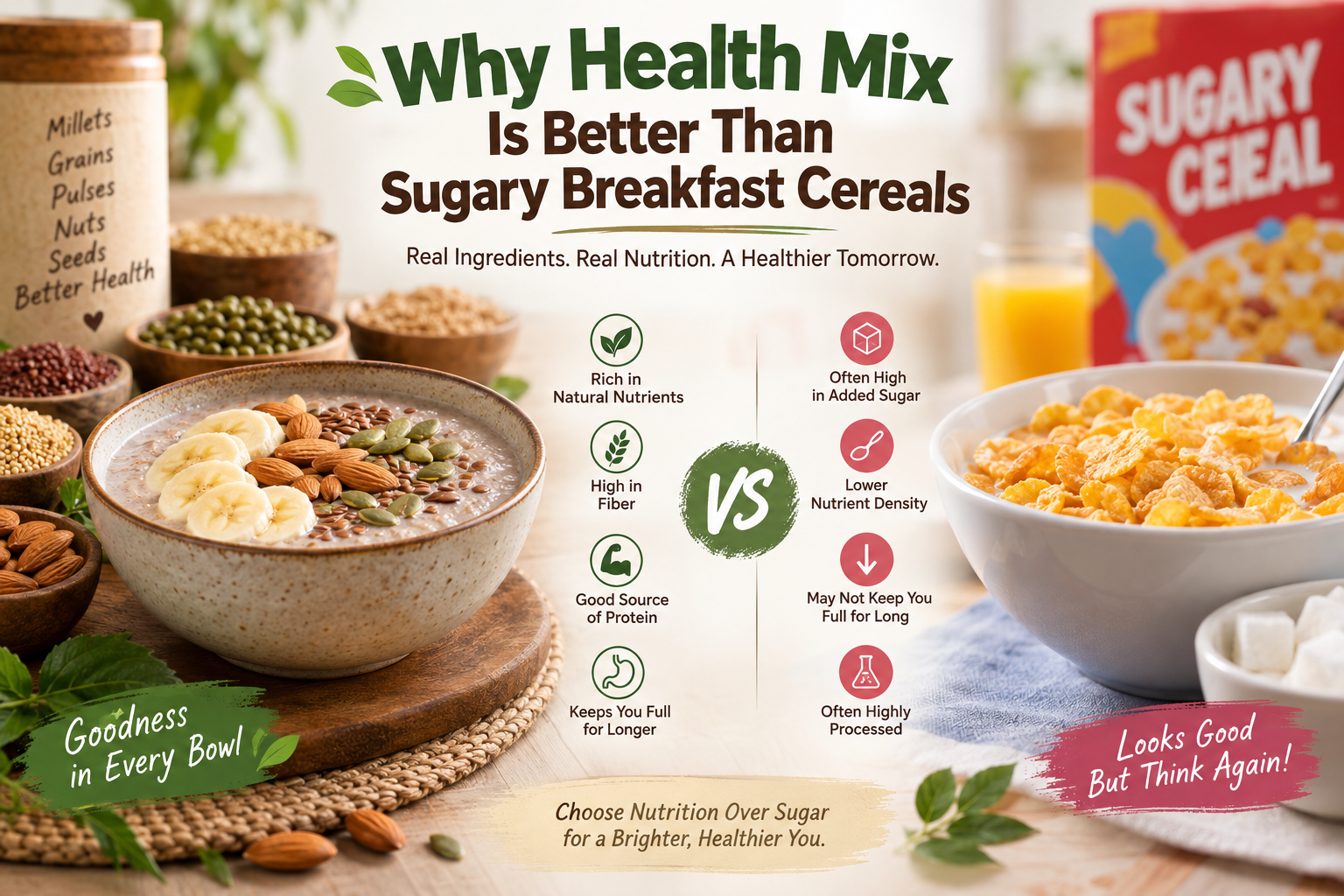
Why Health Mix Is Better Than Sugary Breakfast Cereals?
Breakfast is often called the most important meal of the day. But what you put into that bowl matters more than simply eating something quickly.
A colorful box of breakfast cereal may look nutritious, especially when the package highlights words such as whole grain, high fiber, vitamins or multigrain. Yet some cereals can also contain significant amounts of added sugar.
A traditional health mix, particularly one made from ingredients such as millets, grains, pulses, nuts and seeds, can offer a different approach: getting several minimally processed ingredients into one convenient breakfast.
Is health mix better than sugary breakfast cereal?
A well-formulated health mix can be a better everyday breakfast choice than a sugary breakfast cereal because it can provide a combination of whole grains, millets, pulses, nuts and seeds while keeping added sugar low. However, not every health mix is automatically healthier; always check the ingredients, nutrition information and added sugar before buying.
The key difference is not simply health mix vs cereal. It is nutrient-dense ingredients vs a breakfast product that may contain unnecessary added sugar.
Key Takeaways
- A good health mix can combine whole grains, millets, pulses, nuts and seeds in one food.
- Sugary breakfast cereals can contribute a substantial amount of added sugar to the morning meal.
- Whole grains naturally provide fiber, vitamins, minerals and plant compounds.
- Health mix is not automatically healthy just because the package says “natural” or “multigrain.”
- Choose a health mix with recognizable ingredients and little or no added sugar.
- You can make health mix more balanced by serving it with milk or curd and fresh fruit.
- Portion size still matters. A nutritious food can contribute excess calories when eaten in very large quantities.
What Is Health Mix?
Health mix is a blended food preparation made by combining nutrient-rich ingredients such as grains, millets, pulses, nuts and seeds. These ingredients are often roasted, dried and ground into a powder that can be prepared as a porridge or drink.
The exact recipe varies considerably between households, brands and regions.
A traditional Indian health mix may contain ingredients such as:
- Ragi
- Bajra
- Jowar
- Foxtail millet
- Little millet
- Oats
- Brown rice
- Green gram
- Roasted gram
- Chickpeas
- Almonds
- Peanuts
- Sesame seeds
- Flaxseeds
This variety is one of the biggest advantages of a thoughtfully formulated health mix.
Instead of relying on one grain, you can combine several food groups in a single preparation.
Why Can Health Mix Be Better Than Sugary Breakfast Cereals?
The answer comes down to ingredient quality, added sugar, fiber and overall nutritional density.
A sugary cereal may provide carbohydrates and may also be fortified with selected vitamins and minerals. But fortification does not necessarily make a highly sweetened product equivalent to a meal built around naturally nutrient-rich ingredients.
Harvard’s Nutrition Source recommends choosing minimally processed whole-grain foods and notes that some ready-to-eat breakfast cereals can contain significant amounts of added sugar.
A good health mix can therefore have an advantage when its ingredient list is built primarily around whole-food ingredients.
1. Health Mix Can Provide More Variety in One Serving
One of the most practical advantages of health mix is ingredient diversity.
Consider a simple homemade or traditionally prepared health mix containing ragi, green gram, roasted gram, almonds and sesame.
You are not getting nutrition from just one ingredient. Instead, you are combining:
- A millet
- A pulse
- A legume
- A nut
- A seed
Each contributes a different nutritional profile.
This is particularly useful for busy mornings because the preparation is convenient without requiring you to cook several separate foods.
Why ingredient diversity matters?
Different plant foods provide different combinations of:
- Dietary fiber
- Protein
- Complex carbohydrates
- Healthy fats
- Vitamins
- Minerals
- Phytochemicals
That makes a thoughtfully prepared health mix more than simply a powder to mix with milk.
2. Health Mix Can Be Naturally Lower in Added Sugar
This is one of the biggest differences between a traditional health mix and a sugary breakfast cereal.
Added sugar means sugar introduced during processing or preparation rather than naturally occurring sugars in foods such as fruit or milk.
The FDA lists 50 grams of added sugar per day as the Daily Value based on a 2,000-calorie diet and notes that the Dietary Guidelines for Americans recommend limiting calories from added sugars to less than 10% of daily calories.
That doesn’t mean breakfast cereal is automatically unhealthy.
The issue is the added sugar content of the specific product.
For example, a plain whole-grain cereal with minimal added sugar can be a perfectly reasonable breakfast. A heavily sweetened cereal is a different story.
A simple shopping rule
When buying either cereal or health mix, look beyond the front of the package.
Check:
- Ingredient list
- Added sugar
- Dietary fiber
- Protein
- Serving size
- Type of grains used
- Whether nuts, pulses or seeds are actually present
3. Whole Grains Bring More Than Just Carbohydrates
Whole grains contain three main components:
- Bran
- Germ
- Endosperm
The bran contributes fiber and several micronutrients, while the germ contains vitamins, minerals, healthy fats and plant compounds.
This matters because grain quality is not just about calories.
A health mix containing whole grains or millets can contribute a broader range of nutrients than a breakfast built primarily around refined ingredients.
However, there is an important distinction:
“Multigrain” does not automatically mean “whole grain.”
A product can contain several grains and still be highly processed or contain substantial added sugar.
Always check the actual ingredient list.
4. Fiber Can Help Make Breakfast More Satisfying
Fiber is another important reason to pay attention to whole grains, pulses, nuts and seeds.
Unlike digestible carbohydrates, dietary fiber is not broken down completely into glucose in the digestive tract. It can contribute to fullness and supports normal digestive function.
This makes fiber-rich breakfast combinations useful for people who find themselves hungry again shortly after eating.
For example:
Sugary cereal + sweetened milk
may provide a predominantly carbohydrate-heavy breakfast.
Whereas:
Health mix + unsweetened milk + fruit
can provide a combination of carbohydrates, protein, fiber and other nutrients.
The second option is not automatically perfect, but it is generally a more nutritionally balanced starting point.
5. Pulses, Nuts and Seeds Can Improve the Nutritional Profile
This is where a well-designed health mix can stand apart from a basic cereal.
Pulses and legumes contribute plant protein and fiber. Nuts and seeds contribute healthy fats along with minerals and other nutrients.
For example:
| Ingredient | What it can contribute |
|---|---|
| Ragi | Carbohydrates, fiber, minerals |
| Green gram | Protein, fiber |
| Roasted gram | Protein, carbohydrates |
| Almonds | Protein, healthy fats |
| Sesame | Healthy fats, minerals |
| Flaxseed | Fiber and unsaturated fats |
| Millet | Whole-grain carbohydrates, fiber |
The exact nutrition depends on the recipe and quantities used.
That last point is important. A product containing one almond and a small amount of millet cannot honestly be treated the same way as a mix where these ingredients form a meaningful part of the recipe.
Health Mix vs Sugary Breakfast Cereal: Which Is Better?
| Factor | Health Mix | Sugary Breakfast Cereal |
|---|---|---|
| Ingredient diversity | Often high | Depends on product |
| Added sugar | Can be very low | Can be high |
| Whole grains | Often included | Varies |
| Millets | Common in Indian mixes | Less common |
| Pulses | Can be included | Usually uncommon |
| Nuts & seeds | Can be included | May be absent or limited |
| Fiber | Depends on recipe | Varies significantly |
| Protein | Can be moderate | Often varies |
| Preparation | Usually requires mixing/cooking | Usually ready to eat |
| Label checking | Still essential | Essential |
| Best choice | Low-sugar, ingredient-rich mix | Low-sugar, whole-grain cereal |
The important conclusion
A good health mix generally has more potential for ingredient diversity, while a low-sugar whole-grain cereal can also be a healthy breakfast. The product’s actual ingredient and nutrition profile matters more than the category name.
Does Health Mix Help with Weight Management?
This is one of the most common questions people ask.
Health mix should not be considered a weight-loss food simply because it contains millets or natural ingredients. Weight management depends on overall calorie intake, food quality, activity, sleep and many other factors.
A health mix may be useful in a balanced diet when it provides fiber and nutrient-dense ingredients without excessive added sugar.
However, portion size matters.
Adding large amounts of sugar, jaggery, flavored powders or calorie-dense toppings can significantly change the nutritional profile of the meal.
A better approach
Instead of asking:
“Will health mix make me lose weight?”
Ask:
“Does this health mix help me build a balanced, satisfying breakfast?”
That is a much more useful question.
How to Make Health Mix More Nutritious?
Health mix does not have to be complicated.
Try building your breakfast around three elements:
1. Health mix
Choose a mix based on whole grains, millets, pulses, nuts and/or seeds.
2. Protein-rich accompaniment
Depending on your diet, this could be:
- Milk
- Curd
- Unsweetened soy milk
- Nuts and seeds
- Another protein-rich food
3. Whole fruit
Add seasonal fruit such as:
- Banana
- Apple
- Guava
- Papaya
- Orange
- Berries
This creates a more complete breakfast than simply mixing the powder with sugar.
How to Choose a Good Health Mix?
Not every product marketed as a “health mix” deserves the same nutritional rating.
Before buying, check these five things.
1. Read the ingredient list
Look for recognizable ingredients such as millets, whole grains, pulses, nuts and seeds.
2. Check added sugar
A health mix does not need to be heavily sweetened to taste good.
3. Look at the order of ingredients
Ingredients are generally listed by weight, so the first few ingredients tell you what makes up most of the product.
4. Check allergens
Nut-, peanut-, sesame- and other ingredient-based allergies should be taken seriously.
5. Look at serving size
Nutrition information only makes sense when you compare similar serving sizes.
The FDA recommends using serving size and % Daily Value to compare products, with 5% DV or less generally considered low and 20% or more generally considered high for a nutrient.
Is All Breakfast Cereal Bad?
No. This is an important distinction.
Not all breakfast cereals are sugary cereals.
A plain oatmeal, unsweetened muesli, shredded whole grain cereal or another product with a whole grain as its primary ingredient and little added sugar can fit into a healthy diet.
Harvard’s Nutrition Source recommends choosing breakfast cereals that are low in sugar and contain whole grains, and suggests looking for meaningful fiber content.
Therefore, the better comparison is:
Low-sugar whole-food breakfast vs high-sugar breakfast
—not simply:
Health mix vs cereal.
This distinction makes the advice more useful and trustworthy.
Health Mix for Children: Is It a Good Breakfast?
A nutritious health mix can be included in a child’s breakfast when it is age-appropriate and part of a varied diet.
The Indian Council of Medical Research–National Institute of Nutrition’s dietary guidance includes whole grains, pulses, nuts and other food groups as components of balanced dietary patterns.
For children, avoid treating health mix as a replacement for a diverse diet.
A child’s overall diet should include appropriate combinations of:
- Grains and millets
- Pulses or other protein sources
- Vegetables
- Fruits
- Milk or suitable alternatives
- Nuts and seeds where age-appropriate and safe
For very young children, choking risks and individual dietary requirements need special attention.
A Simple Healthy Breakfast Formula
If you want an easy formula to remember, try:
Whole grains/millets + protein + fruit + minimal added sugar
For example:
Option 1
Health mix porridge + milk + banana
Option 2
Health mix + curd + chopped fruit
Option 3
Unsweetened health mix drink + boiled egg + fruit
Option 4
Plain oats/millet porridge + nuts + fruit
The goal is not to find one magical breakfast.
The goal is to create a breakfast that is nutritious, practical and sustainable enough to eat regularly.
Should You Choose Health Mix Over Sugary Cereal?
If your choice is between a low-sugar, ingredient-rich health mix and a heavily sweetened breakfast cereal, the health mix can be the more nutrient-dense option.
Its potential advantage comes from the ingredients it can combine: whole grains, millets, pulses, nuts and seeds.
But don’t judge a product by the word “health” on its label.
A good health mix should have:
- A transparent ingredient list
- Little or no unnecessary added sugar
- Meaningful whole-food ingredients
- Appropriate serving information
- A nutritional profile that matches your dietary needs
And remember: a low-sugar whole-grain cereal can also be a sensible breakfast.
The best breakfast is not the one with the healthiest-sounding marketing. It’s the one made from quality ingredients that helps you build a balanced diet consistently.
If you’re looking for a convenient traditional breakfast option, explore a well-formulated health mix made with whole grains, millets, pulses, nuts and seeds and compare the label before you buy.
People Also Ask
Is health mix healthier than cornflakes?
A low-sugar health mix containing whole grains, millets and pulses may provide greater ingredient diversity than conventional cornflakes. However, nutrition varies by product, so compare the ingredient list, fiber, protein and added sugar rather than judging by the product category alone.
Can I eat health mix every day?
A suitable health mix can be part of an everyday breakfast when it fits your overall dietary needs. Variety still matters, so rotate ingredients and include fruits, vegetables and other protein sources throughout the day.
Is health mix good for breakfast?
Yes, a well-formulated health mix can be a convenient breakfast option. Combining it with milk or another suitable protein source and fruit can create a more balanced meal.
Does health mix contain sugar?
It depends on the product. Some health mixes contain little or no added sugar, while others may include sugar, jaggery or other sweeteners. Always check the ingredient list and nutrition panel.
Is millet health mix better than sugary cereal?
A millet-based health mix with pulses, nuts or seeds and little added sugar can be a more nutrient-dense choice than a sugary cereal. However, the actual formulation matters more than the word “millet” on the package.
Can children have health mix?
Many children can include an age-appropriate health mix as part of a balanced diet, but ingredients, preparation, allergies, portion size and the child’s age should be considered. Health mix should complement, not replace, dietary variety.
Frequently Asked Questions
What is the main benefit of health mix?
The main advantage of a well-formulated health mix is that it can combine several nutrient-rich ingredients such as whole grains, millets, pulses, nuts and seeds in one convenient preparation.
Is health mix better than sugary cereal for adults?
It can be, especially when the health mix is low in added sugar and contains whole-food ingredients. A low-sugar whole-grain cereal can also be a healthy option.
Is health mix suitable for weight loss?
Health mix is not inherently a weight-loss food. Portion size, ingredients, preparation and your overall eating pattern matter. A low-sugar, fiber-rich mix can fit into a balanced weight-management diet.
What should I look for when buying health mix?
Look for recognizable whole-food ingredients, whole grains or millets, pulses, nuts or seeds where appropriate, low added sugar and clear nutritional information.
Can I replace sugary cereal with health mix?
Yes. A low-sugar health mix can be used as an alternative to sugary breakfast cereal, especially when prepared with a suitable protein source and fruit.
Follow our social media – Instagram


Log in
By continuing, you accept the Website Regulations , Regulations for the sale of alcoholic beverages and the Privacy Policy
You dont have an account yet? Register Now