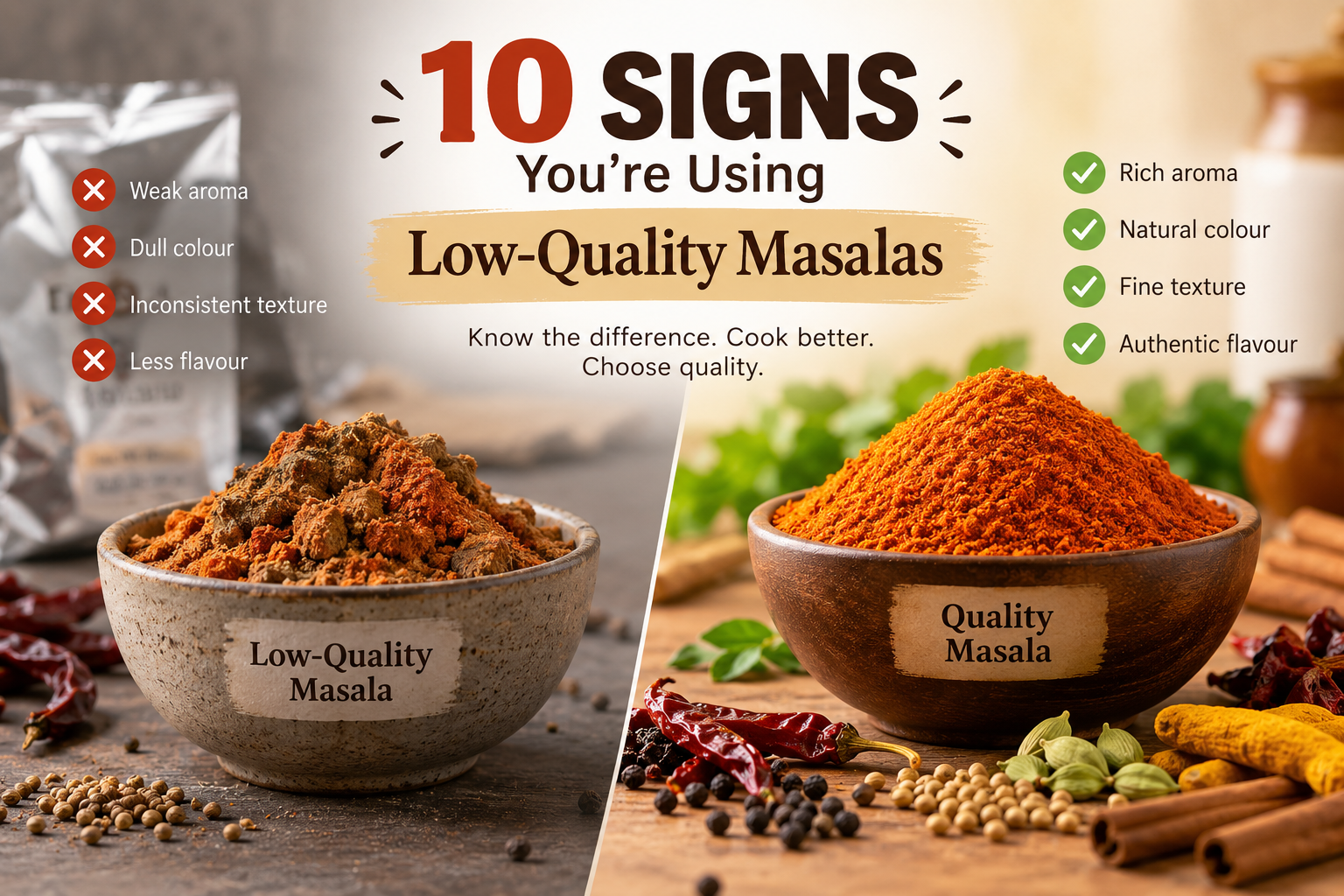
10 Signs You’re Using Low-Quality Masalas
Have you ever followed your usual recipe perfectly, only to find that the curry tastes flat, the biryani lacks aroma, or the masala needs to be added in unusually large quantities?
The problem may not be your cooking.
The quality of your masala can dramatically affect the aroma, colour, flavour and overall character of a dish. A good spice blend should complement the ingredients rather than simply make food hotter, saltier or more intensely coloured.
In India, spices and spice blends are subject to defined quality and food-safety requirements. The Food Safety and Standards Authority of India (FSSAI) has analytical methods covering parameters such as composition, volatile compounds, spice bioactives and adulteration. The Spices Board of India also maintains quality-evaluation laboratories that test spices for chemical, microbiological and physical parameters.
So, how can you tell whether the masala sitting in your kitchen is genuinely good quality?
Let’s look at 10 practical warning signs.
How Can You Tell It Is a Low Quality Masala?
Low-quality masalas often show noticeable signs such as weak aroma, unusually dull or artificial-looking colour, inconsistent texture, excessive fillers, poor flavour, excessive salt, clumping, stale taste, inconsistent results and a need to use much more powder than expected. However, appearance alone cannot prove adulteration or food-safety problems. Proper testing is required to confirm those issues.
Key Takeaways
- Fresh masalas should have a recognizable and natural spice aroma.
- Strong colour does not automatically mean better quality.
- Excessive salt or fillers can reduce the actual spice content of a blend.
- A masala that has lost its aroma may have been stored poorly or may be old.
- Consistency matters: the same masala should produce reasonably similar results each time.
- Packaging, ingredient information, batch details and storage instructions are important buying signals.
- Quality masala is more than colour and heat; it includes raw-material quality, processing, formulation, freshness and food safety.
- Visual and sensory checks can raise questions, but laboratory testing is needed to confirm many forms of adulteration or contamination.
What Does “Quality Masala” Actually Mean?
A quality masala is not simply a spice powder that looks bright or tastes strong.
Quality generally involves several factors: the quality and freshness of the raw spices, the formulation of the blend, cleanliness, appropriate processing, aroma, flavour, texture, packaging and storage.
For example, a chilli powder with an extremely bright appearance may look impressive, but colour alone cannot tell you whether the product has good flavour or meets applicable standards.
Similarly, a masala that tastes extremely salty or spicy may seem powerful initially, while actually delivering less of the characteristic flavour expected from the spices.
This distinction is important because “strong” and “high quality” are not the same thing.
10 Signs You May Be Using Low-Quality Masalas
1. The Masala Has Very Little Aroma
One of the easiest things to notice is aroma.
Fresh spices contain aromatic compounds that contribute significantly to their characteristic smell. When spices are old, poorly stored or have lost volatile compounds during storage, their fragrance can become noticeably weaker.
Open a fresh packet of good-quality masala and smell it before cooking.
You should generally be able to identify the characteristic fragrance of the spice blend. If there is barely any aroma, or if the powder smells flat and lifeless, freshness may be an issue.
What to check
- Does the masala smell immediately after opening?
- Can you recognize the dominant spices?
- Does the aroma disappear almost instantly?
- Does it smell stale rather than fresh?
Practical tip: Store masalas in airtight containers away from heat, moisture and direct sunlight after opening.
2. The Colour Looks Unusually Bright or Inconsistent
Colour is one of the most misunderstood indicators of spice quality.
Consumers often associate a deeper red chilli powder or intensely yellow turmeric with better quality. But colour by itself is not a reliable quality test.
Natural spice colour varies depending on the variety, growing conditions, processing and age.
A better approach is to look for consistency and read the product information rather than judging quality solely by appearance.
If a masala’s colour looks dramatically different from what you normally expect, treat it as a reason to inspect the product more carefully—not as automatic proof of adulteration.
FSSAI’s spice analysis manual includes methods related to composition, spice characteristics and adulteration, demonstrating why proper quality assessment goes beyond simply looking at the powder.
3. You Need to Use a Lot More Masala to Get the Same Flavour
This is a particularly useful real-world quality signal.
Suppose your usual recipe requires two teaspoons of a particular masala. If another product requires four or five teaspoons before the dish develops a comparable flavour, something may be different about its formulation, freshness or spice concentration.
That does not automatically mean the product is adulterated. Different brands use different recipes and proportions.
However, consistently needing much more powder can indicate that you’re getting less flavour impact per spoonful.
A simple comparison
| Observation | Potential explanation |
|---|---|
| Small quantity gives strong aroma | Fresh or well-formulated blend |
| Large quantity needed | Weak flavour or different formulation |
| Strong saltiness before spice flavour | High salt proportion |
| Strong heat but little aroma | Chilli-heavy or unbalanced blend |
| Pleasant aroma and balanced flavour | Better overall sensory profile |
4. The Masala Tastes More Salty Than Spicy
This is particularly relevant for ready-made curry masalas, biryani masalas and other blended products.
Salt can make food taste immediately more intense. But if salt dominates the flavour of a spice blend, the product may not deliver the complex character you’re expecting from the individual spices.
A well-balanced masala should allow its characteristic spices to contribute to the final flavour.
For example, a biryani masala should ideally contribute layers of spice aroma rather than simply increasing saltiness or heat.
Before buying, check:
- Ingredient list
- Salt content where declared
- Spice ingredients
- Recommended serving size
- Whether salt is already included in the blend
5. The Powder Has Excessive Clumping
A little clumping does not automatically mean a masala is poor quality.
Moisture exposure can cause powdered spices to form lumps, particularly after opening. Poor packaging or improper storage can make this worse.
However, persistent hard clumps, moisture-related changes or unusual texture deserve attention.
Moisture is also undesirable from a storage perspective because spices should be protected from conditions that encourage deterioration, infestation and mould growth. Codex guidance specifically emphasizes proper storage to minimize deterioration and prevent infestation and mould growth.
Better storage habits
Keep opened masalas:
- In airtight containers
- Away from the stove
- Away from steam
- Away from direct sunlight
- Using a completely dry spoon
6. The Masala Has a Stale or “Flat” Taste
A masala can look perfectly normal and still have lost much of its flavour.
This is one reason freshness matters.
Ground spices have a larger exposed surface area than whole spices. Over time, their aromatic character can decline, particularly when exposed to air, heat, light and moisture.
A stale masala may still add some colour or heat to food, but the finished dish lacks depth.
You might notice:
“The curry is spicy, but it doesn’t smell like the curry my mother makes.”
That difference can come from freshness, spice proportions, cooking technique—or a combination of all three.
7. The Texture Feels Unusually Fine, Coarse or Inconsistent
Texture isn’t enough to determine quality, but it can provide useful clues.
A masala blend should generally have a reasonably consistent texture appropriate to the product.
For example, a biryani masala designed as a fine powder shouldn’t contain unexpectedly large quantities of hard particles or foreign-looking material.
Spices are also evaluated for physical parameters and foreign matter. The Spices Board’s laboratory services include testing for parameters such as foreign matter, bulk density, added starch and other quality characteristics.
Watch for:
- Unexpected hard particles
- Foreign material
- Unusual fibrous pieces
- Excessively inconsistent grinding
- Texture that differs dramatically between batches
If you notice something genuinely suspicious, don’t rely on a home visual test to identify what it is.
8. Every Batch Tastes Different
Consistency is an underrated sign of a good packaged masala.
If you buy the same product repeatedly, you should generally expect a reasonably similar flavour profile from one packet to the next.
A dramatic difference could result from:
- Variation in raw spices
- Different formulations
- Changes in processing
- Storage conditions
- Product age
- Batch variation
Professional spice quality control involves much more than tasting. The Spices Board’s quality laboratories use analytical techniques including HPLC, LC-MS/MS, GC-MS/MS and microbiological testing for relevant parameters.
In other words, professional quality control is designed to measure things consumers cannot reliably judge at home.
9. The Masala Has an Unpleasant Aftertaste
A good masala should enhance the dish without leaving an unpleasant lingering taste.
Pay attention to what happens several seconds after eating.
Does the flavour remain pleasantly spicy and aromatic?
Or do you notice an unusual:
- Bitter taste
- Artificial taste
- Excessively salty finish
- Burnt sensation
- Chemical-like aftertaste
- Flat, dusty flavour
An unusual aftertaste isn’t proof of a particular adulterant or contaminant. Still, it is a reasonable reason to stop using the product and inspect its packaging, ingredients, storage history and source.
For suspected food-safety problems, laboratory analysis is the appropriate route.
10. The Packaging Doesn’t Give You Enough Information
Sometimes the biggest warning sign isn’t the masala itself.
It’s the information missing from the packet.
When buying packaged masalas, look for clear product information such as:
- Ingredient list
- Net quantity
- Batch or lot information
- Manufacturing/packing details
- Date information
- Storage instructions
- Manufacturer details
- Applicable food-safety information
A trustworthy packaged food product should make it reasonably easy for consumers to understand what they’re buying.
This is especially important when comparing different masala brands online.
Don’t choose solely based on:
❌ Bright packaging
❌ Lowest price
❌ Strong colour
❌ “Extra spicy” claims
❌ Celebrity endorsements
Instead, consider the ingredients, freshness, manufacturing information, reputation, packaging and consistency together.
Low-Quality Masala vs Quality Masala
| Factor | Potentially low-quality experience | Quality-focused product |
|---|---|---|
| Aroma | Weak or stale | Distinct and characteristic |
| Flavour | Flat or one-dimensional | Balanced and layered |
| Saltiness | May dominate | Appropriate to formulation |
| Texture | Excessively inconsistent | Consistent for the product |
| Freshness | Little aroma after opening | Noticeable spice fragrance |
| Cooking performance | Large quantity may be needed | Good flavour impact |
| Batch consistency | Noticeable variation | More predictable |
| Packaging | Limited information | Clear product information |
| Storage | Easily affected by moisture | Better-protected packaging |
| Overall experience | Colour/heat may dominate | Aroma, flavour and balance work together |
Is Darker or Brighter Masala Always Better?
No. Colour alone does not determine masala quality.
The natural colour of spices can vary according to the raw material, variety and processing. A darker chilli powder isn’t automatically better, and a bright yellow turmeric powder isn’t automatically more pure.
This is why experienced buyers look beyond appearance.
A better quality assessment considers aroma, flavour, ingredient information, freshness, processing, packaging and food-safety controls.
Can You Test Masala Quality at Home?
You can perform simple sensory checks, but home tests cannot reliably confirm many types of adulteration.
You can examine:
- Aroma
- Colour
- Texture
- Taste
- Packaging
- Ingredient information
- Batch and date details
- Storage condition
However, detecting contaminants such as mycotoxins, pesticide residues, heavy metals or certain adulterants requires appropriate laboratory methods.
This is important because spice safety is a genuine technical subject. FSSAI maintains a dedicated analytical manual for spices, herbs and condiments, while the Spices Board’s quality laboratories conduct chemical, residue and microbiological analyses.
Why Spice Quality Matters More Than You Think?
Masalas are used in relatively small quantities, but they influence a surprisingly large part of a dish’s sensory experience.
A masala contributes:
- Aroma
- Flavour
- Colour
- Heat
- Complexity
- Regional character
That’s why replacing a low-quality spice blend with a fresher, better-balanced product can sometimes make a familiar recipe taste completely different—even when every other ingredient stays the same.
The global food-safety community also pays close attention to spice quality. Codex has a dedicated code of practice addressing the prevention and reduction of mycotoxins in spices, while international discussions around spices identify issues including microbial contamination, pesticide residues, mycotoxins, filth and impurities.
How to Choose Better Quality Masalas?
Instead of asking only “Which masala is cheapest?”, ask:
1. What are the ingredients?
Look at the ingredient list rather than relying entirely on the front of the package.
2. Does the product have a strong natural aroma?
A fresh, characteristic aroma is an encouraging sensory sign.
3. Is the blend balanced?
You should be able to appreciate the spice profile rather than only salt or heat.
4. Is the packaging suitable?
Good packaging helps protect powdered spices from moisture, air and other environmental factors.
5. Is the brand transparent?
Look for clear product, manufacturer and batch information.
6. Does it perform consistently?
If the same masala gives reliable results across multiple meals, that’s valuable.
Quality Masalas Can Change the Way You Cook
The easiest way to understand masala quality is through your own cooking.
Take one familiar recipe—perhaps sambar, chicken curry, biryani, kurma or rasam—and prepare it using two different spice blends while keeping the other ingredients as consistent as possible.
Pay attention to:
- Aroma while cooking
- Colour of the gravy
- Spice balance
- Depth of flavour
- Aftertaste
- Quantity required
- Overall freshness
You may find that the difference isn’t simply “more spicy” versus “less spicy.”
The real difference can be how many layers of flavour you experience.
Frequently Asked Questions About Masala Quality
What are the main signs of low-quality masala?
The common warning signs include weak aroma, stale flavour, excessive saltiness, unusual texture, inconsistent batches, poor packaging information and needing unusually large quantities to achieve the desired flavour. These signs do not independently prove adulteration.
How can I identify good-quality masalas?
Look for fresh aroma, balanced flavour, suitable texture, clear ingredient information, proper packaging, traceable batch details and consistent cooking performance. A product’s appearance alone should not determine your choice.
Does bright red chilli powder mean better quality?
No. Colour alone cannot establish spice quality or purity. Chilli colour naturally varies with the variety and processing of the spice.
Why does my masala smell weak?
Weak aroma can be associated with age, storage conditions, exposure to air, heat or moisture, or differences in formulation. Ground spices can gradually lose their aromatic character during storage.
Are expensive masalas always better?
Not necessarily. Price is only one factor. Compare ingredients, freshness, formulation, packaging, brand transparency and cooking performance rather than assuming that the most expensive product is automatically the best.
Can low-quality masalas affect the taste of food?
Yes. A masala with weak aroma, stale spices or an unbalanced formulation can make food taste flat, overly salty or one-dimensional, even when the recipe itself is good.
Can I detect adulteration just by looking at masala?
Not reliably. Some physical characteristics can raise suspicion, but confirming adulteration or contamination often requires laboratory analysis. FSSAI and the Spices Board use analytical methods to evaluate spice quality and safety.
How should I store masala after opening?
Keep it tightly sealed in a clean, dry, airtight container away from direct sunlight, heat and steam. Always use a dry spoon to reduce moisture exposure.
Which is better: whole spices or powdered masalas?
Neither is universally better. Whole spices can retain their character well when properly stored and freshly ground, while quality packaged masalas offer convenience and carefully formulated blends. The right choice depends on freshness, formulation and your cooking needs.
Why does the same recipe taste different with different masalas?
Different brands can use different spice varieties, proportions, roasting methods, grinding processes and formulations. Even when the product names are identical, the resulting flavour can differ significantly.
Masala Quality Questions
What should good masala smell like?
It should have a recognizable, pleasant aroma characteristic of its spice blend rather than smelling stale, flat or unusually artificial.
How do I know if my masala is fresh?
Check the date information, packaging condition and aroma. A fresh masala should generally have a noticeable characteristic fragrance.
Is darker turmeric better?
No. Turmeric colour alone is not enough to determine quality.
Why is my curry spicy but not flavourful?
The masala may have an unbalanced spice profile, insufficient aromatic spices, reduced freshness or simply a formulation that emphasizes heat over complexity.
How long does powdered masala stay fresh?
It depends on the spice, packaging, storage conditions and product formulation. Follow the manufacturer’s date and storage guidance rather than relying on one universal timeframe.
Final Thoughts: Don’t Judge Masala by Colour Alone
A great masala does more than make food look colourful.
It should bring aroma, balance, depth and character to the dish.
The next time your curry feels unusually flat or your biryani doesn’t have the fragrance you expected, don’t immediately blame the recipe. Look at the masala you’re using.
Check its aroma. Read the ingredients. Examine the packaging. Think about how much you need to use. Most importantly, pay attention to the difference it makes in your food.
And remember: a sensory warning sign is not the same as proof of adulteration. When food safety is genuinely in question, rely on appropriate testing and reputable products rather than unverified home “purity tests.”
Choose masalas from brands that prioritize quality ingredients, careful processing, freshness, transparent product information and consistent flavour.
Because when the masala is right, even a simple home-cooked meal can taste remarkably better.
Ready to upgrade your everyday cooking? Explore quality masalas and choose spice blends made to bring authentic aroma and flavour to your kitchen.
Buy masalas on – Traditional masala collection
Buy biryani masala – Biryani masala product
Do follow us on Instagram – annaifoodproducts2


Log in
By continuing, you accept the Website Regulations , Regulations for the sale of alcoholic beverages and the Privacy Policy
You dont have an account yet? Register Now