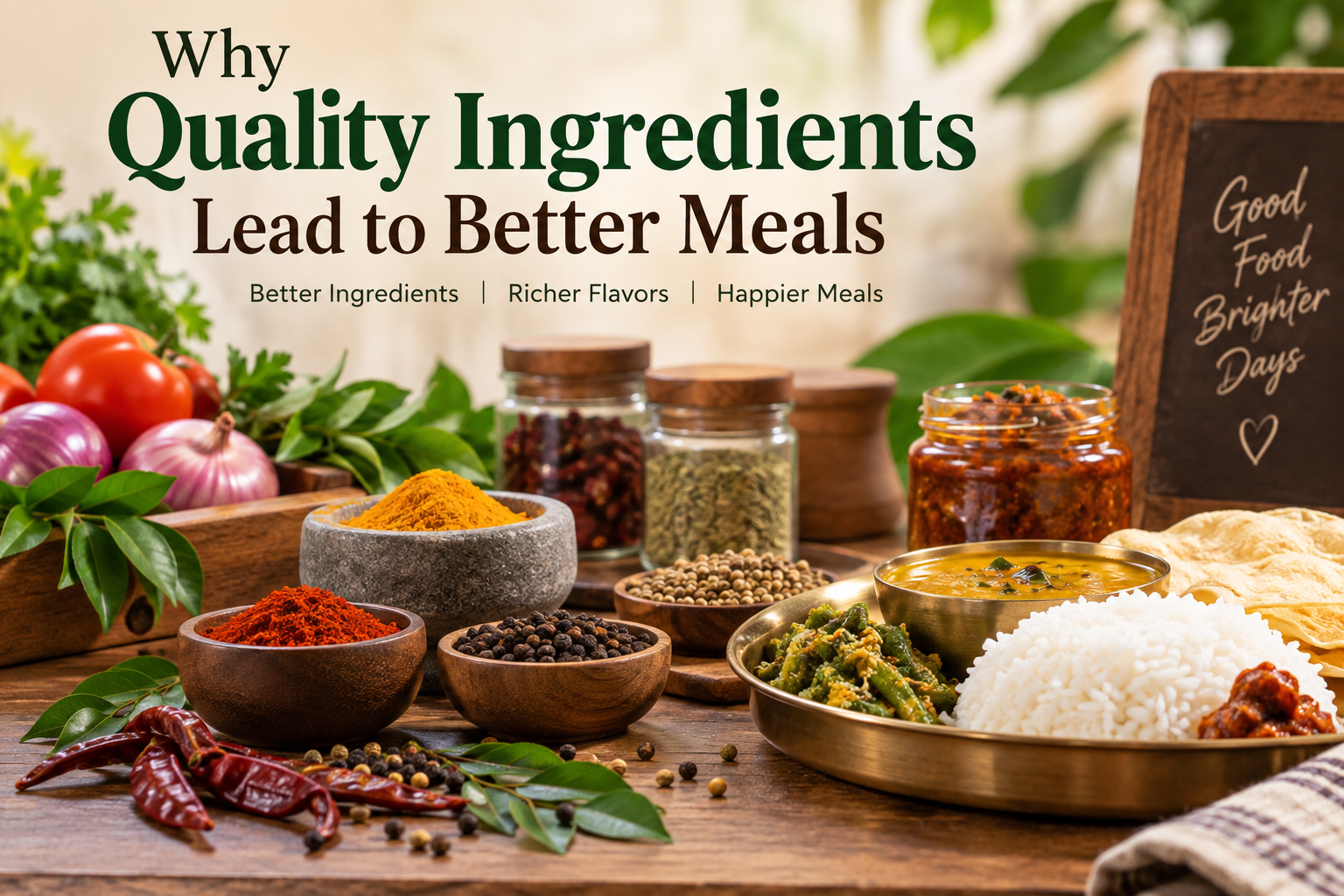
Why Quality Ingredients Make Better Meals?
Have you ever followed a recipe exactly, only to wonder why your dish still does not taste like the one you had at a good restaurant or at home growing up?
The answer is often simpler than the recipe: the ingredients matter.
A fragrant spice, naturally sweet date, properly prepared masala, or fresh pickle can change the character of an entire meal. You do not always need more ingredients or complicated cooking techniques. Sometimes, you simply need better ingredients.
Why Do Quality Ingredients Make Better Meals?
Quality ingredients improve meals because they bring stronger natural flavor, aroma, texture, consistency, and nutritional value to the cooking process. Fresh spices can make food more aromatic, good-quality produce can improve texture, and carefully prepared traditional foods can add depth without requiring complicated recipes.
In simple terms: when the foundation is better, the finished meal has more potential to be better too.
Key Takeaways
- Quality ingredients can make a noticeable difference in flavor, aroma, texture, and overall eating experience.
- Freshness is particularly important for spices, herbs, fruits, vegetables, and other aromatic ingredients.
- Good ingredients do not mean the most expensive ingredients. Quality, freshness, sourcing, and suitability for the recipe matter more.
- Spices and masalas can transform simple everyday foods into more flavorful meals.
- Proper storage is essential because even good ingredients can lose quality over time.
- Traditional foods such as pickles, spice blends, and homemade-style products can add concentrated flavor to everyday cooking.
- Choosing ingredients carefully is one of the easiest ways to improve home cooking without making recipes complicated.
What Are Quality Ingredients?
Quality ingredients are food ingredients selected for their freshness, flavor, nutritional characteristics, appropriate processing, and overall suitability for the dish being prepared.
Quality does not necessarily mean premium-priced or imported. A locally sourced ingredient can be excellent, while an expensive ingredient can be disappointing if it is old, poorly stored, or unsuitable for the recipe.
Food quality itself is multidimensional. Researchers consider characteristics such as flavor, aroma, texture, appearance, nutritional value, safety, shelf life, and processing when evaluating food quality.
For everyday cooking, this means looking beyond the price tag.
Ask:
- Does it smell fresh?
- Does it have good flavor?
- Is it stored properly?
- Are the ingredients clearly listed?
- Does the product suit the dish?
- Is the quality consistent from one purchase to another?
How Do Quality Ingredients Improve the Taste of Food?
The most obvious difference is flavor.
Consider a simple bowl of dal. The basic recipe may contain lentils, salt, turmeric, oil and spices. Yet two versions can taste completely different depending on the quality and freshness of those ingredients.
Aromatic spices contain compounds that contribute to a food’s smell and flavor. When those compounds are fresh and properly used, even a small quantity can have a significant sensory impact.
For example:
Fresh, flavorful masala → stronger aroma → deeper flavor → more satisfying meal
This is particularly noticeable in Indian cooking, where spices often form the foundation of a dish.
Why Spices Matter So Much?
Spices are not simply added to make food “spicy.”
They contribute:
- Aroma
- Sweetness
- Earthiness
- Warmth
- Bitterness
- Savory depth
- Color
- Complexity
Techniques such as tadka demonstrate this beautifully. Heating spices in oil or ghee helps release aromatic compounds and distributes their flavors throughout the dish.
That is why a simple vegetable curry, dal or rice dish can become dramatically more flavorful with a well-made spice blend.
Freshness Is a Major Part of Ingredient Quality
Freshness can influence both flavor and texture.
This is especially important for ingredients whose desirable characteristics decline during storage.
Think about:
- Whole spices
- Ground spices
- Dry fruits
- Dates
- Fresh vegetables
- Herbs
- Pickles
- Flour and grains
- Nuts and seeds
USDA food-quality resources note that the condition of food at the point of processing or freezing can affect its resulting quality, including flavor and texture.
Fresh Spices vs. Stale Spices
One of the easiest ways to understand this is to compare spices.
| Fresh, quality spice | Older or poorly stored spice |
|---|---|
| Strong aroma | Weak aroma |
| Distinct flavor | Flat flavor |
| Vibrant natural characteristics | Dull characteristics |
| Often requires less quantity | May require more |
| Enhances the dish | Can disappear into the dish |
Whole spices generally retain their aromatic qualities better than already-ground spices because grinding increases the surface area exposed to air.
For example, coriander is valued for its floral, earthy and citrus-like character, while its aroma compounds can diminish as the spice ages.
The lesson is simple: freshness is not a marketing word. It can affect what you actually taste.
Quality Ingredients Can Make Simple Meals More Delicious
You do not need an elaborate recipe to enjoy a better meal.
In fact, simple dishes are often where ingredient quality becomes easiest to notice.
Consider these examples:
| Simple meal | Ingredient that can make a difference | Possible result |
|---|---|---|
| Curd rice | Quality pickle | More contrast and flavor |
| Dal | Fresh masala and tadka spices | Deeper aroma |
| Lemon rice | Fresh spices and nuts | Better fragrance and texture |
| Chapati | Good-quality flour | Better taste and texture |
| Rice pudding | Quality dates or dry fruits | Natural sweetness and richness |
| Vegetable curry | Fresh spice blend | More aromatic gravy |
| Breakfast porridge | Premium dates | Natural sweetness and texture |
This is why quality ingredients can be especially valuable in everyday cooking.
You are not necessarily changing the recipe.
You are improving the building blocks of the recipe.
Quality Ingredients and Nutrition: What Is the Connection?
Taste is not the only consideration.
Food ingredients can also contribute to the nutritional profile of a meal. Fruits, vegetables, grains, pulses, nuts, seeds and other minimally processed foods can provide different combinations of nutrients and beneficial compounds.
However, it is important not to assume that a product described as “premium,” “natural,” or “traditional” is automatically healthier.
Instead, evaluate the actual product.
Look at:
- Ingredient list
- Nutritional information
- Added sugar
- Salt levels
- Type of processing
- Portion size
- Storage instructions
- Allergen information
- Product quality and freshness
Food labels can provide useful information about attributes such as ingredients, nutrition, processing and other product characteristics.
Quality Does Not Mean “Healthy” by Default
This distinction matters.
A high-quality pickle can still contain significant salt. A premium sweet can still contain substantial sugar. A traditional food can be excellent while still needing to be enjoyed in sensible portions.
Quality and nutrition are related, but they are not identical concepts.
That is a more useful way to think about food choices.
Why Traditional Ingredients Can Make Everyday Food Special?
There is another dimension to ingredient quality that numbers on a label cannot completely capture: food culture.
Traditional Indian cooking has developed around ingredients, preparation methods and flavor combinations passed from one generation to another.
A good masala is not merely a mixture of powdered spices.
It can represent:
- Regional cooking traditions
- Familiar aromas
- Family recipes
- Seasonal ingredients
- Traditional preparation methods
- Memories associated with food
The same principle applies to homemade-style pickles and traditional snacks.
A spoonful of pickle alongside curd rice or a freshly prepared meal can introduce acidity, saltiness, spice and texture. You may not need to change the main dish at all.
Sometimes, One Good Ingredient Is Enough
This is one of the most practical lessons for home cooks.
Instead of trying to improve every part of a meal, identify the ingredient that has the greatest influence on the final flavor.
For example:
Plain rice + dal + flavorful pickle
can be more satisfying than a complicated meal made with mediocre ingredients.
Quality Ingredients vs. Cheap Ingredients: What Should You Choose?
Price alone is a poor measure of quality.
A better approach is to consider value.
| Factor | Lower-quality choice | Quality-focused choice |
|---|---|---|
| Flavor | May be inconsistent | More distinctive |
| Aroma | Often weaker | More pronounced |
| Freshness | Variable | Better controlled |
| Ingredients | May prioritize cost | Greater attention to ingredient selection |
| Cooking result | Less predictable | More consistent |
| Quantity needed | Sometimes more | Often less may be sufficient |
| Overall experience | Functional | More satisfying |
The goal is not to buy the most expensive product.
The goal is to buy the right-quality ingredient for the food you are preparing.
How to Choose Better Ingredients for Your Kitchen?
You do not need to become a food expert to improve your ingredient choices.
Start with these seven habits.
1. Read the Ingredient List
Do not rely only on the front of the package.
Turn the product around and check what is actually inside.
2. Check Freshness
For products where freshness affects flavor, pay attention to manufacturing or packing information, storage conditions and best-before guidance.
A “best before” date generally relates to quality rather than automatically indicating that food becomes unsafe on that exact day.
3. Buy Ingredients You Will Actually Use
A high-quality ingredient sitting unused in the cupboard is not providing value.
Buy quantities that fit your cooking habits.
4. Store Ingredients Properly
Even excellent ingredients can deteriorate when exposed to moisture, heat, light or air.
Keep dry ingredients in appropriate airtight containers and follow the manufacturer’s storage instructions.
USDA guidance recommends storing shelf-stable foods in cool, dry conditions and following product-specific storage instructions.
5. Prioritize High-Impact Ingredients
Spend more attention on ingredients that strongly influence the dish.
For Indian cooking, this can include:
- Spice blends
- Chili powder
- Turmeric
- Coriander
- Cumin
- Garam masala
- Pickles
- Dry fruits
- Dates
6. Look for Transparent Product Information
A trustworthy food brand should make it reasonably easy for customers to understand what they are buying.
7. Pay Attention to Consistency
If a product tastes good once but varies significantly between purchases, it may not provide the same value as a consistently made product.
How Annai Foods Brings Quality Ingredients Into Everyday Cooking?
For many households, the goal is not to spend hours preparing every ingredient from scratch.
The practical solution is to choose convenient products without losing the character of traditional food.
Annai Foods focuses on products such as homemade-style pickles, traditional masalas, premium dates, health mixes and other food products designed for everyday use.
That makes quality ingredients more accessible for ordinary meals.
A good masala can become part of a weekday curry. A flavorful pickle can instantly complement rice and curd. Dates can provide a naturally sweet addition to breakfast, snacks or desserts.
The idea is not to make cooking complicated.
It is to make familiar food taste better with thoughtfully selected ingredients.
Better Ingredients Do Not Replace Good Cooking
There is one important caveat.
Quality ingredients cannot rescue every cooking mistake.
You still need:
- Correct seasoning
- Appropriate heat
- Proper cooking time
- Good ingredient combinations
- Suitable storage
- Basic food-safety practices
Food quality depends on several factors, including ingredients, processing, storage and preparation.
In other words:
Good ingredients give you better potential. Good cooking turns that potential into a great meal.
That distinction is important.
A Simple Formula for Better Meals
If you want consistently better home-cooked food, use this simple framework:
Quality Ingredients + Freshness + Good Technique = Better Meals
You can apply it to almost any cuisine.
For Indian cooking:
Quality dal + fresh masala + proper tadka = flavorful dal
For breakfast:
Good oats + premium dates + nuts + fruit = satisfying breakfast
For lunch:
Fresh rice + flavorful curry + quality pickle = more enjoyable meal
For snacks:
Good-quality dry fruits + dates + simple preparation = convenient homemade snack
The recipe does not have to be complicated.
Questions About Quality Ingredients
Do quality ingredients really make food taste better?
Yes. Ingredients influence the flavor, aroma, texture and appearance of a dish. Fresh spices and properly stored ingredients can retain more of the characteristics that make food enjoyable.
Are expensive ingredients always better?
No. Price does not automatically determine quality. Freshness, sourcing, processing, storage, ingredient composition and suitability for the recipe are often more useful measures.
Why are fresh spices important?
Fresh spices generally have stronger aromas and more pronounced flavors. As spices age, their volatile aromatic compounds can decline, which may make the finished dish taste flatter.
What ingredients should I prioritize for better cooking?
Focus first on ingredients that have a major influence on the dish. For Indian cooking, these can include spice blends, whole spices, chili, turmeric, coriander, cumin, pickles, dates and other flavorful ingredients.
Can quality ingredients improve simple meals?
Absolutely. Simple dishes often make ingredient quality easier to notice because there are fewer competing flavors.
How should I store quality ingredients?
Follow the product’s storage instructions. In general, many dry ingredients benefit from cool, dry and well-sealed storage, while perishable foods require appropriate refrigeration or freezing.
Better Meals Start with Better Choices
Great cooking does not always begin with a complicated recipe.
It often begins when you open the cupboard and choose an ingredient that smells fresh, tastes authentic and has been made with care.
Quality ingredients give everyday cooking a stronger foundation. They can improve aroma, flavor, texture and consistency while helping simple dishes feel more satisfying.
You do not need to replace everything in your kitchen.
Start with the ingredients you use most.
Choose them carefully, store them properly and learn how to use them well.
Because sometimes, the difference between an ordinary meal and a memorable one is simply what you put into it.
Ready to make everyday meals more flavorful?
Explore Annai Foods’ range of traditional pickles, masalas, premium dates and other food products and bring more authentic flavor into your everyday cooking.
3. FAQs
1. What are quality ingredients?
Quality ingredients are foods selected for freshness, flavor, texture, nutritional characteristics, appropriate processing, safety and suitability for a particular recipe.
2. Why do quality ingredients matter in cooking?
They can improve the flavor, aroma, texture and consistency of the finished dish, making even simple recipes more enjoyable.
3. How can I identify good-quality spices?
Look for a strong natural aroma, appropriate color and clear product information. Store spices away from moisture, heat and direct light.
4. Do homemade-style food products taste better?
They can offer distinctive traditional flavors and preparation styles, but quality depends on the actual ingredients, preparation, storage and product consistency.
5. What is the most important ingredient for a better meal?
There is no single best ingredient. Prioritize the ingredients that contribute most strongly to the dish’s flavor and character.
Annai Foods Collection
Annai Foods Pickles collection
Annai Foods Masalas collection
Annai Foods Dates collection
Annai Foods Health Mix collection


Log in
By continuing, you accept the Website Regulations , Regulations for the sale of alcoholic beverages and the Privacy Policy
You dont have an account yet? Register Now